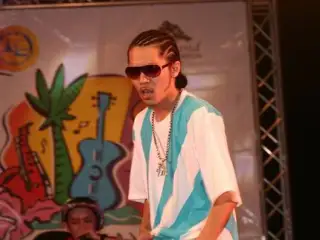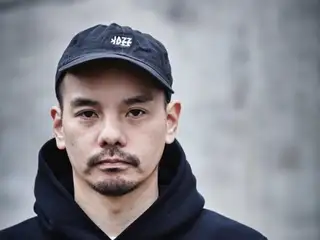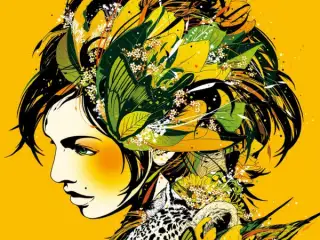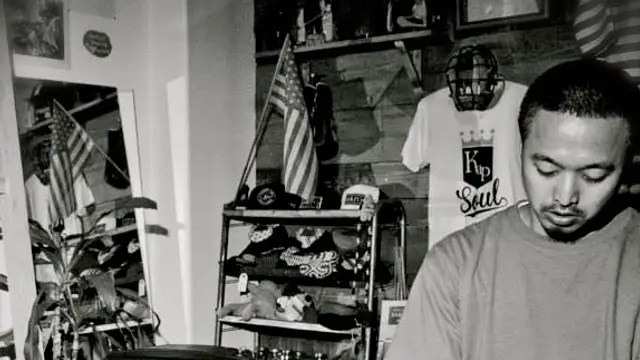
Picture a teenager in suburban Japan, late at night, headphones pressed tight against his ears, rewinding a cassette for the fourth time. The tape hisses, the drums settle into a pocket so deep it feels geological, and somewhere in the warmth of a looped piano, something shifts permanently. The music is A Tribe Called Quest, or J Dilla, or Slum Village — it doesn't matter which precisely, because the effect is the same. The groove reaches across the Pacific and rearranges something interior. This is where BudaMunk's story begins: not with a plane ticket or a competition trophy, but with the act of listening so hard that a sound from another world becomes your own.
The Suburb, the Crate, and the Signal from Across the Pacific
Japanese hip-hop fandom in the 1990s ran on an infrastructure of obsession. Import record shops in Tokyo and Osaka stocked twelve-inches that had barely finished pressing in New York or Detroit. Dubbed tapes passed between schoolmates with handwritten tracklists. Late-night radio programmes — some hosted by producers who had made the pilgrimage to the Bronx and returned as evangelists — played records that most listeners had never seen the sleeves of. For a generation of young Japanese listeners, American underground hip-hop arrived neither as novelty nor imitation. It arrived as a transmission carrying complete emotional authority.
The question of why music rooted so specifically in Black American urban experience found such resonance among Japanese youth is worth sitting with rather than explaining away. It was not simply that hip-hop had gone global by the decade's end. The underground variants — the sample-heavy, spiritually warm work of the Tribe and the Dilla school — operated on frequencies that needed no translation. Rhythm is its own grammar. The particular ache of a looped soul record, the snap of a drum machine running slightly off the grid, the way a great beat creates space rather than filling it: these are not culturally coded in ways that require decoding. They land because they are honest.
BudaMunk grew up inside this listening culture, developing the kind of ear that forms only through sustained, private engagement with music treated as sacred. Before he ever touched an MPC, before Los Angeles was anything more than a name on a map, he had already built an internal library of textures and feelings — the warmth of vintage samples, the looseness of human-feeling drums, the philosophy of production as composition rather than backing track. His biography is the story of someone who arrived at a craft through years of deep listening, then went looking for the community that made the sounds he loved.
To frame that early period as mere backstory is to miss the argument it makes. Deep listening across borders is itself a form of immersion. The Japanese teenager rewinding a Slum Village tape is doing something more than fandom — he is apprenticing himself to a tradition, learning its values before he knows its vocabulary. BudaMunk's journey began long before he boarded a plane.
Los Angeles as a Second Education: Scene, Mentorship, and the MPC as Language
Moving to Los Angeles at sixteen, BudaMunk did not arrive as a tourist cataloguing hip-hop culture from a safe observational distance. He arrived as a student prepared to be shaped by it. The Los Angeles underground beat scene of the early 2000s was a genuinely generative environment — a network of record stores, open sessions, and community spaces where beatmakers pushed each other relentlessly, where the MPC was treated not as a machine but as a conversation partner, and where craft was the only credential that carried consistent weight.
The city has its own particular genius for this kind of underground community. Los Angeles's sprawl — its car culture, its patchwork of immigrant neighbourhoods, its quality of being simultaneously everywhere and nowhere — produces a certain kind of artist: one who moves between scenes rather than belonging to a fixed one, who absorbs influences laterally rather than hierarchically. For a young Japanese producer still finding his footing, the city offered both anonymity and access. Nobody was asking where he came from. They were listening to what he made.
In 2005, the Scratch Academy held its first-ever MPC Tournament — a competition putting beatmakers head to head in a live forum, making tracks in real time on the machine that had defined hip-hop production for two decades. BudaMunk won it. As the inaugural edition of the competition, his victory was not simply a personal milestone — it was a data point about how seriously the underground community had received him as a practitioner. Not as a curiosity. Not as a representative of some exotic geography. As a craftsman who belonged in the conversation.
The MPC is worth understanding as a cultural object as much as an instrument. Mastering it — not just technically but intuitively, knowing how to let it breathe, how to exploit its particular limitations as expressive tools — means entering a lineage that runs through Dilla and Pete Rock and Q-Tip and back further still. It is a form of fluency. BudaMunk's years in Los Angeles gave him that fluency not through study but through immersion: through the daily friction of making music alongside people for whom these machines and these traditions were lived inheritance.
The Return: Bringing Something Real Back to Tokyo
When BudaMunk returned to Japan, the Tokyo hip-hop landscape he encountered had its own established logic — its own gatekeepers, its own hierarchies between performer and producer, its own relationship to American source material. The scene had grown substantially since the 1990s. Japanese producers and MCs had built a domestic industry with its own star system and aesthetic vocabulary. But something the Los Angeles underground had in abundance — the communal, craft-obsessed, practice-first culture of the beatmaker sessions — was harder to locate.
Jazzy Sport provided the infrastructure through which BudaMunk's return found its fullest expression. More than a record label, Jazzy Sport functions as a cultural institution — a shop, a curatorial network, a node connecting Tokyo to the wider global independent hip-hop circuit. Its significance lies in understanding that the most meaningful music does not belong to national scenes but to a global conversation, and in creating space for artists who exist at that intersection. For BudaMunk, it was the right home: a platform that understood his dual formation without requiring him to explain it.
What he carried back to Tokyo was not simply a sound. It was an ethos — the understanding that beatmaking is a communal practice, that the culture surrounding the music is inseparable from the music itself, that craft developed in relationship to other craftspeople carries a different authority than craft developed in isolation. His value to the Tokyo scene was as much philosophical as it was sonic.
His instrumental work under the name through & through operates as cultural translation that does not announce itself as such. The music does not wear its cross-cultural origins on its sleeve or gesture toward its own hybridity. The Los Angeles years and the Tokyo years and the suburban Japanese bedroom years are all fully metabolized into a sound that simply is what it is — warm, unhurried, architecturally precise in its looseness. That invisibility of origin is the achievement.
Boom-Bap Without Borders: What BudaMunk's Story Reveals About Global Hip-Hop
The dominant narrative of hip-hop's global spread is a story of American export: the music travels outward, is adopted by local scenes, and arrives transformed but always with New York or Los Angeles or Detroit as the point of origin. BudaMunk's story complicates this map substantially. He represents a bidirectional flow — a figure who traveled toward the source, was genuinely changed by it, and returned carrying something that fed back into both the global and the local conversation.
The distinction between surface-level aesthetic adoption and genuine community immersion matters enormously here, and it is a distinction that hip-hop communities themselves have always been alive to. What attracts the charge of appropriation is the extraction of aesthetic surface without relationship to the culture that produced it — the costume without the commitment. What BudaMunk did in Los Angeles was the opposite: he submitted himself to a community on its own terms, developed his craft inside its logic, and earned his standing through the work rather than claiming it through proximity or imitation.
The global underground has always had its own passport system. Credibility in the beatmaking world is not issued by geography but by practice — by the quality of what you build and the seriousness with which you build it. Figures from Brazil, from the UK, from South Korea, from Japan have moved through this system for decades, building reputations inside scenes far from their birthplaces by doing the simple and demanding thing of showing up and being good. BudaMunk's 2005 tournament win is a historical marker of that system functioning — a young Japanese producer judged purely on what he made, in real time, on the machine.
Instrumental hip-hop plays a specific role in cross-cultural transmission worth naming. Without lyrics, without language as a potential barrier or cultural marker demanding interpretation, beat music travels with unusual freedom. Through & through asks only that you listen — to the drums, to the texture of the samples, to the architecture of the arrangement. That openness is not simplicity. It is a different kind of complexity: the complexity of music that must be entirely itself because it cannot lean on words.
The Architecture of Influence: J Dilla, Slum Village, and the Lineage BudaMunk Extends
Every producer is a conversation with the producers who came before them, and BudaMunk's primary interlocutors are unmistakable. The Dilla and Slum Village tradition carries specific, identifiable qualities: the deliberate looseness of quantization that makes drums feel human and slightly drunk, the warmth of vintage soul and jazz samples treated with reverence rather than merely mined for material, the philosophical commitment to feel over technical precision. In this tradition, the slightly imperfect is the deeply human, and the deeply human is the point.
BudaMunk's engagement with this lineage is not replication but dialogue. His Japanese sensibility — shaped by different musical touchstones, different aesthetic traditions, a different relationship to space and restraint — introduces something genuinely new into the conversation. The warmth is there, but it sits differently. The drums breathe in a particular way. There is a quality of negative space in his arrangements that feels distinctly Japanese without being decorative: it is structural, purposeful, the silence as load-bearing as the sound.
The through & through project carries within it a philosophical statement about beatmaking itself — that an instrumental producer is not a composer awaiting a vocalist but a complete artist expressing a complete vision. This is very much a Dilla inheritance: the beat tape as finished work, the sequence of instrumentals as an argument about what music is for. BudaMunk understood this not as theory but as practice, and his output reflects an artist who has fully internalized the idea that the groove is the destination, not the vehicle.
There is a paradox worth sitting with in how geographic distance from a source can deepen engagement with it. The Japanese teenager who cannot take the music for granted, who must work to obtain it and has no casual relationship to its cultural context, may develop a more rigorous and searching relationship with its essence than someone for whom it is simply ambient. Japan has a long tradition of this kind of devotion to imported forms — its jazz musicians, its reggae selectors, its soul collectors have consistently demonstrated that love across distance produces a particular intensity of listening. BudaMunk belongs to that tradition as surely as he belongs to any hip-hop lineage.
Place as Practice: What Tokyo and Los Angeles Sound Like Together
BudaMunk's music does not announce its dual citizenship, but it carries both cities inside it. Listen carefully and you can hear Los Angeles in the low-end warmth, in the sun-bleached quality of certain samples, in the relaxed confidence of the arrangements — a music that knows it does not need to rush because it is going somewhere worth arriving at. And you can hear Tokyo in the precision beneath the looseness, in the care with which space is managed, in the sense that every element has been considered and placed with intent. These are not competing qualities. They are the same quality approached from two directions.
The most enduring cross-cultural music is not fusion in the branding sense — not a calculated blend designed to signal its own hybridity. It is the natural result of an artist whose identity cannot be reduced to a single place, who has lived genuinely in multiple cultural registers and made something from the sum of all of them. BudaMunk did not set out to make music that was Japanese and American simultaneously. He set out to make music honest to everything he had heard, felt, and learned. The dual geography is a consequence of that honesty, not a strategy.
Jazzy Sport's role in this story is that of the institution that understood the duality and gave it room. By connecting BudaMunk's work to a global network of independent beat culture — scenes in Europe and the Americas and across Asia — while remaining rooted in a specific Tokyo context, Jazzy Sport demonstrated what the best independent labels do: hold local specificity and global conversation in productive tension, refusing to flatten one into the other. BudaMunk's music sounds like what it sounds like partly because it had a home that understood what it was.
For younger producers in Japan and elsewhere who feel pulled between their cultural inheritance and their musical influences — who wonder whether the music they love from elsewhere is theirs to make — BudaMunk's story offers no roadmap, only an example of what full commitment to a practice, carried across borders, can produce. The answer to the question of authenticity is not found in biography or geography. It is found in the hours of listening, the years of practice, the willingness to be genuinely changed by the communities that shaped you.
BudaMunk's significance is not that of an ambassador carrying hip-hop between nations, nor of a bridge connecting scenes that could not otherwise touch. It is simpler and more demanding than either of those roles. He is an artist who went looking for the music he loved, found it, gave years to learning its deepest language, and came home with something earned. The groove he makes does not need to explain where it comes from. It arrived through sacrifice and study and time, and it sounds exactly like that — like something that was worth every mile.

Share
Sign in to join the conversation. Sign in
No comments yet. Be the first to share your thoughts.