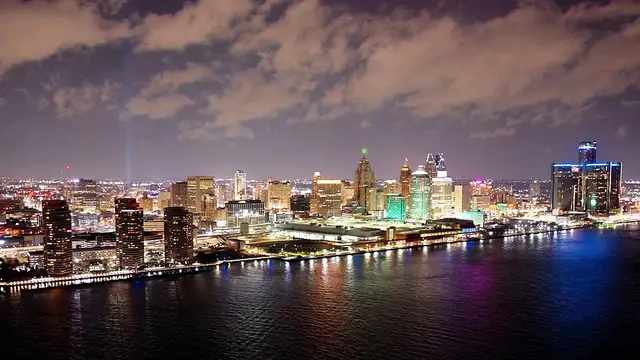
Stand on West Grand Boulevard in Detroit and look at the white two-story house at number 2648. It is a modest building on a residential street, indistinguishable from its neighbors except for a small sign above the front door that reads Hitsville USA. Inside those rooms, between 1959 and the early 1970s, musicians and producers created a body of recorded work that altered the emotional vocabulary of popular music across the planet. The house is a museum now, carefully preserved, but what makes it remarkable is not its architecture. It is the fact that it sits in the middle of a neighborhood, surrounded by homes where people live, an arrangement that was not accidental. It was a consequence of geography, racial exclusion, and the particular ingenuity that emerges when a community is denied access to the places where culture is supposed to be made.
Detroit's musical history is inseparable from this logic. The docuseries Living for the City — taking its title from Stevie Wonder's 1973 composition, a piece of music that treated the American city as both protagonist and antagonist — sets out to prove that Detroit's music cannot be heard in full without understanding the city that produced it. Wonder's song was not merely a social observation; it was a structural argument running beneath the rhythm section and the string arrangements: the city shapes the people, and the people shape the sound. The docuseries adopts this as methodology, using archival footage, resident testimony, and geographic mapping to build a case that has been accumulating evidence across six decades. This article adopts the same framework.
The City as Instrument: Why Place Produces Sound
Detroit was designed for industrial labor. Its grid was organized around the rhythms of the assembly line (the shift change, the commute, the spatial separation of work and home), and its neighborhoods were stratified by race through housing policy that was explicit in its intentions and durable in its consequences. Redlining, restrictive covenants, and the strategic placement of highways carved the city into zones of privilege and exclusion long before the auto industry began its contraction. These were not incidental conditions. They were structurally embedded in the music that would emerge from them, as surely as the tuning of an instrument is embedded in the sound it produces.
Musicologists and urban theorists have increasingly treated Detroit as a case study in what happens when a community denied conventional cultural infrastructure builds its own. The result, they argue, is not a diminished version of mainstream culture but a distinct and often more durable one, built to survive on its own terms and answerable to its own community rather than to external industry gatekeepers. Across three distinct eras and genres, the same conditions recur as generative forces: Black working-class community, the presence and later catastrophic absence of industrial capital, and physical space that could be repurposed for experimentation. These were not obstacles that Detroit's musicians overcame. They were the raw materials from which the music was constructed.
What Living for the City argues, and what the evidence of Detroit's musical history confirms, is that the city functioned as an instrument in its own right — its geography, its economics, and its social architecture producing frequencies that could not have been generated anywhere else, and that have continued to resonate long after the specific conditions of their creation changed.
Hitsville and the Assembly Line of Soul: Motown as Industrial Art
Berry Gordy founded Motown Records in 1959 with an $800 loan from his family and a vision that was as much organizational as artistic. He had worked on the Ford assembly line, and he understood vertical integration not as a metaphor but as a practical system. Motown's West Grand Boulevard operation was structured accordingly: separate departments for songwriting, artist development, quality control, and promotion functioning as interdependent stations on a production line. Songs moved through the system, were tested, refined, and either passed or rejected at a weekly meeting that functioned with the rigor of a factory floor inspection. The result was not accidental hit-making but a deliberate manufacturing process applied to human creativity.
The Motown Sound — dense orchestration, call-and-response vocals, a pop-accessible sheen laid over gospel and blues roots — was simultaneously an aesthetic vision and a calculated strategy. Gordy understood that in a segregated America, Black music needed to be legible to white audiences to cross the market barriers that restricted Black artists to the so-called race record charts. The sound was engineered for crossover without erasing its origins, a tension that made it both commercially extraordinary and culturally complex. It was music that carried its resistance quietly, in the architecture of the arrangement rather than the content of the lyric.
Central to that sound were the Funk Brothers, the largely uncredited house band who played on virtually every hit the label released through the 1960s. They were a community of Black Detroit jazz musicians whose improvisational sophistication was disciplined, session by session, into a repeatable commercial format. The tension between their artistic range and the structured demands of the production line mirrors the broader condition of Detroit's Black working class — extraordinary skill deployed within a system that controlled the terms of its value. The Funk Brothers' story, told definitively in the 2002 documentary Standing in the Shadows of Motown, is a microcosm of the larger story Living for the City sets out to document.
When Gordy relocated the label to Los Angeles in 1972, Detroit experienced it as abandonment. The institution built by and for the community had extracted its value and departed, a pattern that would repeat itself with far more brutal consequences when the auto plants began to close. Motown's departure was not simply a business decision; it was a civic rupture, one that the city's musical culture would spend the following decades absorbing and answering.
After the Line Goes Dark: Deindustrialization and the Conditions for Techno
Between 1950 and 1980, Detroit lost roughly half its population. Auto manufacturing contracted as plants automated, relocated, or shuttered entirely. White flight accelerated the hollowing of the tax base, withdrawing both capital and political will from communities built around the assumption of permanent industrial employment. What remained was a landscape of abandoned infrastructure — factories, warehouses, commercial buildings — spread across a city designed for a population twice its remaining size. The vacancy was staggering, and it was also, paradoxically, generative.
Juan Atkins, Derrick May, and Kevin Saunderson — the Belleville Three — grew up in Belleville, a suburb southeast of Detroit, in the late 1970s and early 1980s. They encountered the synthesizer-driven compositions of Kraftwerk and Giorgio Moroder alongside the funk and soul broadcasting from Detroit's radio stations, and they understood, instinctively, that these were not incompatible worlds. The hybridization they produced is captured in Derrick May's famous formulation: George Clinton and Kraftwerk stuck in an elevator. What emerged from that collision was techno, not simply a genre but a philosophical position, a decision to claim the aesthetic language of the machine as a form of cultural ownership over the industrial forces that had dismantled their parents' world.
Techno was music made by people who had grown up watching machines displace human labor. The mechanical pulse of a Roland TR-909 was not an abstraction for them; it was a direct reference to a world they knew and had seen unmade. The Music Institute club, active in Detroit from the mid-1980s, was a physical space made possible by deindustrialization — low rents, empty buildings, and a city government too financially strained to police underground culture. Economic crisis had created accidental freedom, and the community that gathered in those spaces understood exactly what they were doing with it.
When techno migrated to Europe (to Berlin after reunification, to the UK rave scene, to the clubs of Amsterdam and Brussels) it was received as futurist abstraction, a music of cold technology and forward momentum. In Detroit, it had always been civic music: rooted in the specific experience of a Black Midwestern community navigating the wreckage of the postindustrial American city, full of grief and defiance and a very particular kind of pride. That context did not travel with it, and the distance between how Detroit techno was made and how it was consumed elsewhere is one of the defining ironies of late twentieth-century musical culture.
Rap in the Ruins: Detroit Hip-Hop and the Politics of Visibility
Detroit's relationship to hip-hop developed in a city carrying its own deep musical identity, one largely overlooked by the coasts during the genre's commercial expansion through the 1980s and 1990s. That double condition — rich internal culture, external invisibility — shaped the particular character of Detroit rap. Its references were neighborhood-bound and regionally specific, its scenes insular by design, and its community infrastructure operated entirely outside the mainstream industry apparatus. Artists like Esham and the Insane Clown Posse built audiences of fierce regional loyalty precisely because they had no interest in, and no access to, the systems defining commercial success elsewhere.
The producer born James Dewitt Yancey in Detroit in 1974 — known as J Dilla — represents the fullest synthesis of the city's musical genealogies. His work drew on the orchestral warmth of Motown, the rhythmic displacement of funk, and the sample-based architecture of hip-hop, processing these inheritances through a sensibility so individual that critics and fellow artists have struggled to contain it within any existing category. Dilla's beats operated on a sense of time that was deliberately imperfect, stretched and displaced in ways that conventional sequencing avoided, creating a rhythmic language that felt simultaneously ancient and unclassifiable. His death in 2006 at thirty-two, from a rare blood disease, condensed an extraordinary body of work into a career that continues to influence producers across genres and continents.
Detroit's hip-hop community sustained itself through record stores, independent radio stations, and neighborhood studios functioning as autonomous cultural infrastructure in a city where institutional support for artistic production had effectively collapsed. The geography — sprawling and auto-dependent, resistant as a matter of physical fact to the centralization that characterized New York or Los Angeles — produced a scene that was more neighborhood-specific and, in many ways, more insular. That insularity contributed to both the depth of the scene's local roots and the relative slowness of its national recognition, a dynamic Living for the City traces as part of a longer pattern of Detroit's creative output being undervalued until it became impossible to ignore.
Eminem's commercial breakthrough in the late 1990s brought international attention to Detroit rap and simultaneously raised the questions that always attend the extraction of a marginalized community's culture by someone positioned to access mainstream markets more easily. Those questions — about race, authenticity, and the distribution of benefit from a city's creative labor — are not unique to Detroit, but the city's history makes them unusually legible. Living for the City engages with them directly, treating Eminem's story not as an anomaly but as another chapter in a very long account of how Detroit's music has generated value that has mostly traveled elsewhere.
Frequency as Legacy: What Detroit's Music Teaches the World About Making Culture from Crisis
Detroit's three major musical exports — Motown soul, techno, and its distinct strain of hip-hop — share a structural characteristic that goes deeper than geography or chronology. All three were built by Black communities working with limited institutional resources, using available technology and physical space in ways their designers never intended. The recording console in a residential house on West Grand Boulevard; the drum machines and synthesizers purchased secondhand by teenagers in a depopulated suburb; the basement studios and independent pressing plants of a city whose mainstream cultural institutions had either left or collapsed. This pattern of creative repurposing has analogues elsewhere — in Kingston's sound system culture, in the funk and baile funk of São Paulo's periphery, in Chicago's house scene, in the Afrobeats emerging from Lagos's informal neighborhoods — but Detroit documents it with unusual completeness.
The danger in celebrating this pattern is well understood by the makers of Living for the City. The implicit argument — that deprivation is creatively productive — is a romanticization that erases the human cost and risks treating poverty and abandonment as aesthetic resources rather than as political failures. The docuseries holds both truths simultaneously: that extraordinary creative work emerged from Detroit's conditions of crisis, and that those conditions represented a catastrophic failure of civic and economic justice that destroyed lives, shortened life expectancies, and concentrated suffering in Black communities already systematically excluded from the city's prosperity. The music is not compensation. It is evidence.
Detroit's musical legacy has generated enormous global economic value — in streaming royalties, festival economies, fashion, film, and the tourism built around Hitsville's museum and the mythology of techno's origins. Very little of that value has been returned to the neighborhoods where the music was made. The Funk Brothers played on recordings that earned billions and died in relative obscurity. The Belleville Three created a genre that sustains a global club economy and never received the financial recognition that European artists who adopted their innovations did. J Dilla's catalogue generated significant revenue after his death, much of it flowing through an industry infrastructure his community had always been positioned outside of. Living for the City treats this structural irony as central to any honest account of the city's cultural history, not as a footnote but as the argument itself.
Cities across the world facing deindustrialization, demographic shift, and civic disinvestment have looked to Detroit as a precedent. Post-industrial cities in northern England, the rust belts of eastern Europe, depopulated coastal cities in South America — all have encountered the Detroit story and attempted, with varying degrees of wisdom, to draw lessons from it. The lessons are real but not simply transferable. Detroit's music did not emerge because the city was poor; it emerged because specific communities, with specific histories and specific forms of collective knowledge, responded to their conditions in ways that were irreducibly particular. The conditions can be replicated; the community and its history cannot.
What Living for the City ultimately insists upon is that Detroit's music is not a series of isolated genre moments — not three separate success stories that happened to occur in the same metropolitan area — but a continuous civic conversation, conducted across generations and across forms, about what it means to make culture in a city that the broader economy has decided to abandon. That conversation is still ongoing, in venues and studios and community spaces that carry the same architectural DNA as Hitsville USA and the Music Institute. The past is not a museum exhibit in Detroit. It is an active inheritance, contested, unresolved, and still producing sound.

Share
Sign in to join the conversation. Sign in
No comments yet. Be the first to share your thoughts.