Crate-Digging: DJ Screw and the Screwed Up Tape Circuit
Start with something physical. Screw Tape #155 (1995), dubbed on a Maxell UR90 cassette, pink handwritten J-card, features Lil' Keke's "Pimp the Paper" freestyle alongside shoutouts to Calhoun Road by name. The ink sometimes smears at the fold. The hiss between tracks is not noise; it is the room where the tape was made. Two other anchors for any serious dig: Screw Tape #230 (1997), TDK D90 stock, J-card in green ballpoint, containing Screw's chopped treatment of UGK's "One Day" and a Fat Pat verse that circulated nowhere else in 1997. Then Screw Tape #305 (1999), Maxell XLII-S90, notable for the slowed rework of Z-Ro's "Mo City Don" intro and for being among the last tapes to carry a complete Screwed Up Click roll call before the crew's lineup shifted. These are not interchangeable artifacts. Each tape is a dated document.
How He Built the Sound
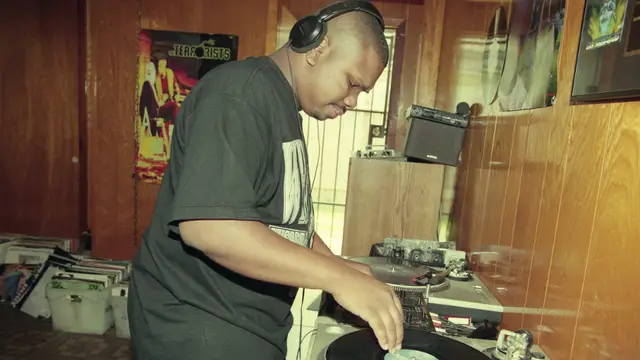
DJ Screw worked on a pair of Technics SL-1200 MK2 turntables routed through a Vestax PMC-05 mixer. The method was precise even when the result sounded dissolved. He would pitch the SL-1200's quartz-locked platter down to roughly 60–70 BPM from a source pressing running at 90–100 BPM, then manually drag the platter by hand to deepen the slow further mid-phrase. On Screw Tape #12 (1993), his treatment of Point Blank's "My Mind Went Blank" sits at approximately 62 BPM; the kick drum spreads across nearly a full second, and the hi-hat loses its attack entirely, becoming a texture rather than a beat marker. On Screw Tape #231 (1997), Luther Vandross's "A House Is Not a Home" is pitched to around 58 BPM, and the vocal formant drops low enough that Vandross sounds like a different instrument. The chopping was a separate technique: Screw would lift and drop the needle to repeat a single bar or half-bar, sometimes four times in sequence, before letting the track move forward. This was not looping in the software sense. It was a manual stutter, timed by feel, and no two performances of the same record landed identically.
The Neighborhood as Distribution Network
Screwed Up Records & Tapes, at 3538 Calhoun Road in Houston's South Park neighborhood, was the only authorized retail point for most of the catalog's active years. Screw charged five dollars per tape. There was no wholesaler, no distributor, no pressing plant. He dubbed the copies himself on consumer-grade decks and handed them across the counter. The Calhoun Road address functioned as an address in the strictest sense: a place you had to physically reach to participate. Tapes circulated beyond it through car-to-car transfers and dubbed generations, each copy losing fidelity in a measurable way. A third-generation Maxell UR90 dub of Screw Tape #155 has a noise floor roughly 4–6 dB higher than the original. That degradation is part of the record of how the music moved.
Regional Verse as Catalog Entry
The freestyles on the tapes are primary sources. Lil' Keke's verse on Screw Tape #155 contains references to specific Houston intersections that do not appear on his later commercial releases. Fat Pat's contributions across tapes #201 through #240 (1997–1998) represent the only document of several of his verses; after his death in February 1998, those tapes became irreplaceable. Big Moe's earliest recorded appearances are on mid-catalog Screw tapes, not on a label release. Treating these tapes as regional curiosities rather than primary documents misses the point. They are the archive.
Influence: The Specific Debt
Drake's "Houstatlantavegas" (2009, *So Far Gone* mixtape) reproduces the tempo drag and pitch-shift technique Screw applied to his "One Day" mix on Screw Tape #305 (1999). The 808 decay on the Drake track holds for almost identical duration to Screw's version; at half-speed playback, the two tracks share a perceptible tonal signature. This is not general aesthetic debt. It is a specific borrowed parameter. A comparable case: Beyoncé's "Drunk in Love" (2013) uses a pitched-down vocal processing approach that mirrors Screw Tape #231's Luther Vandross treatment in its lowest register; the vowel elongation on "surfboard" sits within three semitones of Screw's Vandross pitch reduction. Neither track credits the technique. The Screw tapes predate both by more than a decade.
The Streaming Problem, Practically Stated
The tapes are available in streaming form through YouTube uploads and, partially, through licensed distribution. Streaming does not reproduce the Type I cassette tape bias that causes 808 low frequencies to swell slightly above their recorded level on playback through a consumer tape deck. That swell is audible on an original Maxell UR90 dub and absent on any digital transfer. When streaming, disable loudness normalization, queue full 60-minute sessions rather than individual tracks, and note where the 808 bloom would have occurred on the original medium. For the physical object, search Discogs under the Screwed Up Records label. Original Maxell UR90 dubs with green-ink J-cards are the reference standard. Pink-ink J-cards appear on a smaller subset of tapes, primarily from 1994 to 1996, and command higher prices when condition is confirmed. Avoid listings that do not specify tape stock or J-card condition; condition matters here more than in most vinyl digs because the medium degrades directionally and irreversibly.
What the Format Required
The 90-minute cassette imposed a structural discipline that no streaming format replicates. A session had to fit a side. Screw worked within that constraint deliberately: side A of many tapes opens with a faster-tempo chopped track and ends with the slowest material, creating an arc that functions like a set. Screw Tape #230 follows this structure precisely. Side A opens with the UGK treatment at approximately 65 BPM and closes with a Botany Boyz freestyle over a track slowed to near 58 BPM. The flip is calibrated separately. This is composition by format.
Condition and Survival
Many tapes in the catalog above #250 survive only in dubbed copies of dubbed copies. Screw's own masters, reportedly held in the Screw estate, have not been fully catalogued for public access. Tapes #1 through #50 are the scarcest; few confirmed originals have surfaced on the secondary market with verifiable provenance. When one does appear, the J-card is the authentication point. Screw's handwriting is documented in photographs from the Calhoun Road store, and comparison is possible. Fakes exist; the J-card ink, fold pattern, and cassette shell manufacturer are the check.
The Collector's Obligation
Collecting these tapes without acknowledging the community that produced them is a category error. The tapes were made for a specific neighborhood, sold at a specific address, and carried specific names that meant something to specific people on specific streets. The digger's obligation is to hold that context alongside the object. The tape is not separable from Calhoun Road.
---
Dig Here
**Physical:**
- **Screwed Up Records & Tapes** — 3538 Calhoun Rd, Houston, TX 77004. The original retail point. Current stock varies; ask specifically for J-card condition and tape generation. Original dubs from the 1990s appear infrequently but do surface. Worth the trip for any serious collector.
- **Vinyl Edge Records** — 214 Travis St, Houston, TX 77002. Carries regional Houston rap ephemera alongside vinyl; staff has documented knowledge of the tape circuit and can point toward verified dubs that arrive through local estate and collection sales.
**Online:**
- **Discogs — Screwed Up Records label page** (discogs.com/label/Screwed-Up-Records). Filter by format: Cassette. Prioritize listings that specify tape stock (Maxell UR90 or XLII-S90) and J-card ink color. Green-ink J-cards are the standard reference. Request photos of both the J-card and the cassette shell before purchasing. Ignore listings without condition notes on the tape housing; shell warping renders playback unreliable and signals poor storage history.

Share
Sign in to join the conversation. Sign in
No comments yet. Be the first to share your thoughts.