

The Dancefloor Has Always Been a Place of Becoming
Picture the Warehouse on Chicago's South Side in the late 1970s — walls slicked with condensation, Black and queer bodies moving through sound like it was shelter. House music was never prototyped in a studio for a market. It was built in rooms where certain people had no other room to be fully themselves, and that necessity lodged itself in every kick drum and chord voicing.
From the Warehouse to the Paradise Garage to the Loft, the genre's original architects — Larry Levan, Frankie Knuckles, David Mancuso — were assembling a survival language from R&B, gospel, jazz, and soul. That emotional pluralism wasn't a stylistic preference; it was load-bearing. Every subsequent generation produced artists who pressed a specific human face and cultural address into the form: Larry Heard's devotional minimalism, Kerri Chandler's soulful industrialism, Masters At Work's New York swagger.
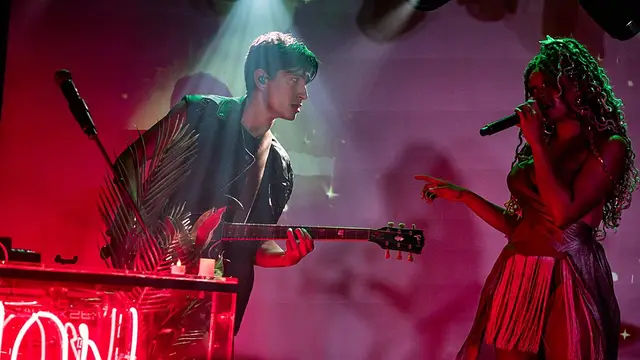
House has always held a productive tension between dancefloor anonymity and personal vulnerability — between the groove that dissolves the individual self and the lyric that insists on one. LIONBABE don't resolve that tension by picking a side. They hold both at once, which is precisely what the tradition demands.
Who LIONBABE Are and Where They Come From
Jillian Hervey and Lucas Goodman formed LIONBABE in New York City, a place whose musical geography — Brooklyn loft parties, downtown club basements — functions as a continuous education in how sound and community reshape each other. Hervey, daughter of actress and disco icon Vanessa Williams, grew up inside music's commercial and artistic worlds simultaneously, developing a working knowledge of both pop craft and cultural lineage that most artists spend a career trying to acquire.
Goodman brings a producer's structural intelligence to the partnership, building tracks that move between genres without hemorrhaging coherence or emotional direction. Early mixtapes and collaborations — among them work alongside Pharrell Williams — signaled a refusal to be pinned to a single lane before the duo had delivered a debut album. The name LIONBABE suggests something feral and tender at once, a duality that threads through everything they make.
The Sound Architecture: Where House Lives in Their Music
LIONBABE's music doesn't announce itself as house — it simply moves the way house moves. Percussion frameworks drawn from classic Chicago and New York templates sit beneath layered vocal arrangements carrying the melodic weight of soul and funk records. Hervey's voice channels both the preacher-like authority of gospel house and the sensual restraint of 1970s soul singers, drawing intimacy through tracks engineered for large rooms.
Goodman's production uses analog warmth and synthesizer texture in ways that echo the lo-fi humanity of early house without embalming it in nostalgia — the records feel alive rather than archival. Songs like "Jungle Lady" and "Jump Hi" demonstrate how the duo deploys build and release, the central emotional grammar of house, across structures that also satisfy pop listeners. Their use of silence within dense arrangements is a distinctly house sensibility: the groove breathes, which is what separates living music from mere mechanism.
Cultural Fluency as Creative Strategy
LIONBABE move across Black American music history, global club culture, and contemporary pop with an ease that reflects deep listening rather than trend surveillance. Funk, Afrobeat, neo-soul, and disco appear not as samples or aesthetic cosplay but as structural logic — the music understands why those forms worked and applies those lessons forward. Their visual identity, bold and rooted in Black beauty traditions, insists that the music's cultural origins stay visible rather than being laundered for crossover palatability.
In an era when Black-originated genres are routinely adopted and credited elsewhere, LIONBABE's explicit rootedness in lineage functions as cultural activism. Their ability to move between festivals, intimate club nights, and pop stages without losing coherence reflects the genre-fluid intelligence of artists who know that a great song holds up in any room — and that knowing where a sound comes from is inseparable from knowing how to carry it forward.
Emotional Depth as Dancefloor Philosophy
The most radical thing LIONBABE do is insist that vulnerability and euphoria aren't opposites. House music at its greatest — Larry Heard's "Can You Feel It," the deep house tradition that followed — has always been capable of profound longing alongside physical transcendence. LIONBABE work fluently in that register. Hervey's lyrics engage with love, identity, self-determination, and Black womanhood with a specificity that distinguishes their music from the deliberate emotional abstraction of much club-oriented production.
The audience for music demanding both physical and emotional engagement has always existed but has rarely been served consistently by a single artist or duo. Live performance sits at the center of LIONBABE's practice: their sets treat the dancefloor as a communal emotional space rather than a venue for individual physical release. That distinction — between communion and consumption — is precisely what house music's originators intended, and what much commercial dance music has abandoned in favor of pure mechanism.
What LIONBABE's Existence Means for House Music's Continuing Story
House music's history is one of constant reinvention by artists who loved it enough to push it forward without demolishing its foundations. Every significant chapter has been written by artists simultaneously fluent in tradition and restless within it. LIONBABE occupy exactly that position. Their reach across Europe, Africa, and beyond continues house music's own extraordinary migration outward from Chicago warehouses to Ibiza dancefloors, from Lagos to Seoul.
By maintaining artistic independence and resisting pressure to flatten their sound for mainstream gatekeepers, LIONBABE model the creative sustainability the underground has always prized and the mainstream has always struggled to accommodate. Their existence as a Black woman and her creative partner making uncompromising club music carries weight in a genre landscape where credit for Black-originated sounds routinely migrates away from Black artists. House music's future — like its past — will be written by those who treat the dancefloor as a space adequate to the full range of human experience. LIONBABE are among the clearest voices making that argument, in the language the music has always spoken.

Share
Sign in to join the conversation. Sign in
No comments yet. Be the first to share your thoughts.