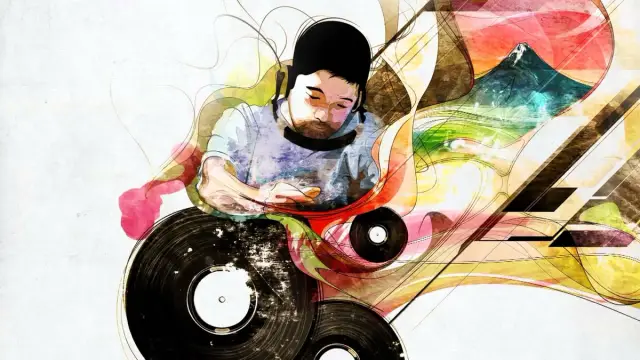
Nujabes: The Architecture of Attention
Picture a record shop in Shibuya. Not the kind that sells chart singles or discounted box sets near the train exit, but the kind that requires you to know it exists — a narrow staircase, fluorescent light, wooden crates sorted by someone's private logic, the smell of aged cardboard and vinyl dust. In the 1990s, Shibuya was one of the densest concentrations of recorded music on earth, its back streets and upper floors holding shops that specialized in rare jazz pressings, obscure soul imports, and the full international sweep of hip-hop's first two decades. It was here that Jun Seba ran a store and built a listening education that no formal institution could have provided.
The name Nujabes is an anagram of Jun Seba — a quiet act of self-invention, coded and interior, that tells you something essential about how he worked. He was not interested in declaring himself. He was interested in the music, in what it could hold, in what could be built inside the space between a jazz chord and a hip-hop kick drum. The cultural conditions that shaped him were specific: Japan had developed one of the world's most devoted jazz collector cultures from the 1960s onward, treating American music not as background entertainment but as an object of near-scholarly attention. In Tokyo's vinyl underground, the details mattered — pressing quality, original versus reissue, the particular grain of a saxophone recorded in a specific studio in 1959.
This relationship to American music — reverent, exacting, deeply absorbed — was not imitation. It was transformation. Japan's distance from the cultural originating points of jazz, soul, and hip-hop meant that its most serious listeners encountered those traditions without the ambient noise of proximity, free to love them on purely sonic terms. Seba came up surrounded by diggers who traded rare pressings and argued over obscure session musicians, and it gave him a lateral relationship to genre. He did not need any single tradition to resolve into something commercially legible. He just needed it to feel true.
Tokyo's geography reinforced this insularity. The city's music scenes coexisted in density without necessarily intersecting, each occupying its own physical and cultural floor. The hypermodernity of the surface — the screens, the fashion, the velocity — sat alongside traditions of extraordinary patience and craft. It was a place that could produce a producer who listened obsessively for years before releasing a single note under his own name, and who, when he finally did, sounded like no one else.
The Architecture of Metaphorical Music
When *Metaphorical Music* arrived in 2003, released on Seba's own Hydeout Productions label, it did not sound like a debut trying to announce itself. It sounded like a complete aesthetic vision that had simply been waiting for the right moment to be documented. Jazz samples floated over slow hip-hop rhythms, sustained but never resolved, space functioning as a compositional element with as much weight as any note. The tempos — mostly in the 75 to 90 BPM range — created breathing room that demanded attention without commanding movement. This was music for sitting inside, not dancing to.
The decision to release on Hydeout was not merely practical — it was structural. By controlling his own label, Seba retained complete autonomy over tempo, sequencing, and aesthetic direction, none of which would have survived the standard machinery of either the Japanese major label system or the American hip-hop industry. He could make albums that functioned like essays, with transitions between tracks designed to sustain a single emotional state across an entire listening session rather than deliver a sequence of discrete commercial moments. This approach predated, by a decade or more, the broader conversation around artist-owned labels and independent creative control that would eventually reshape how the music industry understood itself.
The collaborations with MC Shing02 introduced a lyrical register that matched the music's philosophical depth. The rapping drew loosely from Buddhist and Eastern philosophical frameworks — meditations on impermanence, perception, the interior life — without being didactic or decorative. The words and the production were operating in the same register, asking the same questions. It was a rare alignment of vocal and instrumental voice, and it would deepen across the subsequent years of their collaboration.
What the album argued, structurally and emotionally, was that music could communicate through restraint. That the distance between sounds — the held note, the delayed beat, the unresolved sample — carried as much meaning as the sounds themselves. This was not a new idea in jazz. It was a radical recontextualization in hip-hop, and *Metaphorical Music* made the case with an assurance that should have seemed impossible for a debut record.
Modal Soul and the Sound of Grief Made Beautiful
The title of his 2005 album was a deliberate invocation. *Modal Soul* pointed toward Miles Davis's modal period — *Kind of Blue*, *Sketches of Spain* — and the discovery Davis had made in the late 1950s: that harmony could suspend time rather than move through it, that a chord could be a place to inhabit rather than a step in a progression. Seba's use of that reference was not nostalgic. It was precise. He had found in modal jazz a structural answer to something he was already reaching for, a method that matched his intuition about what music could do to a listener.
*Modal Soul* deepened what *Metaphorical Music* had established, introducing more prominent live instrumentation alongside the samples and giving the production a warmth that purely sample-based work rarely achieves. The organic unpredictability of live playing — slight variations in timing, the breath in a flute phrase, the resonance of a struck piano string — created a textural richness that worked on listeners slowly, below the level of conscious attention. The album had longer compositional arcs, more willingness to let a mood extend without resolution, a quality of longing that resisted simple description.
The ongoing collaboration with Shing02 produced some of the catalog's most enduring work here, including the *Luv(sic)* series — tracks that function as sustained meditations on friendship, memory, and transience. The series, which Shing02 eventually completed posthumously with parts five and six after Seba's death, stands as one of the most ambitious extended compositions at the intersection of hip-hop and jazz aesthetics. Each installment added a new layer to a conversation about what it means to love someone across time, what remains after the immediate intensity of feeling has passed.
*Modal Soul* reached listeners internationally despite almost no conventional promotional infrastructure — no label with distribution deals, no media campaign, no tour. It spread through online music communities and file-sharing networks in the mid-2000s, carried by individual listeners who pressed it on one another with the urgency of a discovery they couldn't keep to themselves. The album's emotional texture — melancholic but never despairing, introspective but never solipsistic — answered a hunger that existed well beyond Japan's borders, one that most music was not designed to address.
Samurai Champloo and the Politics of the Anachronistic
When director Shinichiro Watanabe commissioned Nujabes to score *Samurai Champloo* in 2004, he was not simply hiring a producer for a soundtrack job. He was recognizing a philosophical alignment. *Samurai Champloo* was built on a central conceit — hip-hop culture, with its breakbeats, its cyphers, its codes of honor, dropped into Edo-period Japan — that mirrored almost exactly what Seba had been doing in music: placing American Black musical traditions inside a Japanese sensibility without resolving the tension between them. The collision was the point. The anachronism was not a gimmick but a theoretical position.
Watanabe's proposal was that hip-hop and samurai culture shared a deeper structural preoccupation — with code, with honor, with the weight of the past pressing on the present moment. The swordfighter and the b-boy were both practitioners of a discipline that demanded total presence and carried the lineage of everyone who had practiced before them. Nujabes's music made this argument viscerally convincing. "Battlecry," featuring Shing02, became one of the defining pieces of the era, its opening bars immediately recognizable to a generation of listeners who encountered it in adolescence and carried it forward as a kind of internal landmark.
The soundtrack featured Nujabes alongside fellow Japanese producer Fat Jon, creating a collaborative document that expanded the aesthetic beyond a single vision without losing its coherence. The two producers worked in complementary registers, Fat Jon's contributions adding variety and surprise within an overall tonal consistency that felt like a unified artistic world. For many international listeners, *Samurai Champloo* — which reached North and South America, Europe, and beyond through its global broadcast and Adult Swim distribution in the United States — was the first point of contact with Nujabes's work.
The anime became the most powerful international distribution mechanism his music ever had. Audiences who had no prior access to Japanese underground hip-hop, and who might never have encountered *Metaphorical Music* or *Modal Soul* through normal channels, found themselves arrested by the score of a late-night animated series and began pulling the thread backward into his catalog. The show's global circulation did for Nujabes what no promotional infrastructure could have accomplished — and it did it by being exactly as strange and uncompromising as his records.
Hydeout Productions and the Infrastructure of Independence
Hydeout Productions was never a vanity imprint. It functioned as a curatorial space — a small roster built around a coherent aesthetic identity, a direct relationship between creator and audience, and a refusal to make commercial concessions that would have diluted what made the music significant. At a time when independent infrastructure in Japanese hip-hop was sparse and the global independent music economy looked nothing like it would a decade later, this was a genuinely unusual thing to build.
The label's most significant act of artistic development beyond Seba's own work was the signing and nurturing of Uyama Hiroto, whose solo catalog extended Hydeout's sound into new instrumental territory. Hiroto's work — melodic, introspective, grounded in jazz and classical influence — demonstrated that the aesthetic Seba had built was generative enough to sustain independent artistic development, that it was a language rather than a style, capable of being spoken in new voices. His releases under the label became their own objects of devotion for listeners who had arrived through Nujabes and were looking for somewhere to go next.
The physical releases from Hydeout — vinyl editions, carefully produced packaging — became collector objects with real secondary market value, reflecting both the scarcity of independent Japanese hip-hop releases and the intensity of attachment they inspired. There is something fitting in this: a label built by a man whose musical education took place in vinyl crates, producing records that would end up in other people's crates decades later, circulating through the same economy of attention and care that had shaped their creator.
The label's catalog has continued to generate revenue and circulation long after Seba's death, sustained by streaming platforms and a global fanbase that grew substantially in the years following his passing. The choices that looked limiting at the time — slow tempos, long sequences, no radio concessions — turned out to be precisely the choices that gave the music its staying power. He was not building a commercial infrastructure optimized for scale. He was building a curatorial one optimized for durability.
The Philosophy of Impermanence and Why the Music Keeps Arriving
Jun Seba died in a traffic accident on February 26, 2010. He was thirty-six years old. His death was not widely reported outside Japan at the time — global awareness of his work grew substantially in the years that followed, meaning that a significant portion of the listeners who know his music most deeply encountered it already knowing it was a complete and closed body of work. They arrived at *Metaphorical Music* and *Modal Soul* the way one arrives at a book by an author who died before you were old enough to read, which gives the experience a particular quality: the work is already whole, already finished, already carrying its own ending inside it.
It would be easy, and wrong, to argue that the tragedy of his death is what gives the music its weight. The music had its weight before February 2010. What it carries — philosophically, compositionally — is a sustained engagement with impermanence, with the beauty of things that pass, with the quality of attention that becomes possible when you stop trying to hold onto the moment and simply inhabit it. This was not a posthumous reading imposed by grief. It was what Shing02 was rapping about on *Luv(sic)* while Seba was still alive, still behind the boards, still building.
The lo-fi hip-hop phenomenon that emerged across YouTube channels in the mid-2010s drew directly and unmistakably on the aesthetic grammar Nujabes established — slow tempos, jazz samples, emotional restraint, music designed for late-night introspection rather than peak-hour energy. The origins of that aesthetic in Seba's work are often underacknowledged in mainstream accounts, which tend to locate the genre in internet culture rather than in the specific human intelligence that gave it its form. The streams are attributed to channels and playlists; the grammar came from a record shop in Shibuya.
Shing02's completion of the *Luv(sic)* series — extending it to parts five and six after Seba's death, working from existing production and his own continuing relationship with the themes they had explored together — stands as one of the most sustained acts of artistic tribute in contemporary music. It honored Seba's philosophy not by preserving it in amber but by extending it, by continuing the conversation, by treating the work as alive rather than as a monument.
What Nujabes made was not a genre, though genres have grown from it. It was not a scene, though scenes have claimed it. It was something closer to a mode of listening — one that asks its audience to slow down, to pay attention, to sit inside a feeling rather than move through it. In a musical culture organized almost entirely around acceleration, novelty, and the relentless replacement of one moment by the next, that invitation remains as rare and necessary as it ever was. The music keeps arriving because what it is asking of us has not yet been answered. It probably won't be. That's the point.

Share
Sign in to join the conversation. Sign in
No comments yet. Be the first to share your thoughts.