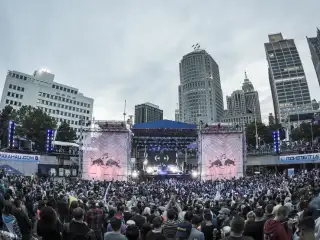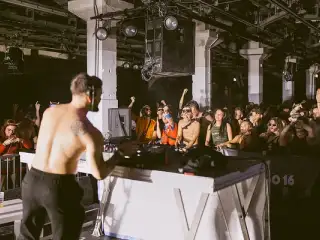
Picture the Sub Club on a Sunday night sometime in the early 2000s. The ceiling is low enough that the bass feels structural, as if the room itself is generating it rather than the speakers. There is no natural light. There has never been natural light. The crowd on the dancefloor has been here for hours and will be here for hours more, sustained by a kind of collective agreement that nowhere else in Glasgow — perhaps nowhere else in Britain — is doing what this room is doing right now. Upstairs, the city's characteristic rain is making the cobblestones of Jamaica Street shine under orange sodium light. Down here, none of that exists. The geography is the point.
That image carries a logic that runs through Scottish electronic music across its entire documented history: the logic of the enclosed space, the self-sufficient scene, the culture that develops its values in productive isolation from the approval structures that govern taste elsewhere. To understand Barry Can't Swim — the Glasgow-based project of producer and multi-instrumentalist Josh Dibb — you have to understand the room, the city, and the generational chain of artists who preceded him. His work did not emerge from nowhere. It emerged from a very specific somewhere.
The Geography of the Outsider
Scotland occupies an unusual position within the British music industry — neither outside it entirely nor at its centre. London's A&R infrastructure, its media concentration, its geography of tastemaking, has historically made the capital the default gravitational point for ambitious British musicians. Glasgow and Edinburgh are not far by European standards, but culturally and industrially, the distance has functioned as something more significant than mere miles. For electronic artists in particular, who were never especially welcome in the mainstream industry machinery anyway, that distance became a kind of gift.
The concept of the creative periphery — the idea that distance from dominant taste-making structures encourages formal risk-taking — applies with unusual clarity to Scotland. When there are no A&R scouts at the back of the room, you make music for the people in front of you. When no one from a major publication is flying up to review your night, you build an audience through the accumulated trust of the dancefloor rather than through critical consensus generated elsewhere. The result is a function-first aesthetic: music calibrated to room response, to bodies, to the specific acoustic character of the spaces available to you. This is not an accident of talent but a product of conditions.
There is also a specific charge to Scotland's cultural relationship with England that goes beyond geography. Scotland is not a postcolonial scene in the way that some global music cultures are, but neither is it simply a regional variant of English culture. The ambivalence — the sense of being adjacent to power without being centred in it, of sharing a language and an industry while maintaining a distinct cultural identity — has shaped Scottish artistic self-presentation across generations. It produces a characteristic combination of seriousness and wry deflection, high ambition and local accountability, that recurs in artist after artist. And the physical texture of Scottish cities — post-industrial, architecturally dense, lit by a particular quality of grey northern light — has been cited repeatedly by artists as shaping the emotional temperature of what they make.
Lineage: From Optimo to Rustie to Sophie
Any account of Scottish electronic music that treats it as a collection of isolated breakthroughs is missing the point. There is a documented generational chain here, and its values — eclecticism, emotional directness, dancefloor rigour — are not coincidental. They are the recurring expression of a shared set of conditions and a shared set of spaces.
Optimo, formed in 1997 by JD Twitch and JG Wilkes, established the template. Their Sunday night residency at the Sub Club became, over the course of the early 2000s, one of the most significant club nights in Europe — not because it was the loudest or the most commercially successful, but because it was built on a principled refusal of genre logic. Techno could follow post-punk. Dance classics could follow noise music. The dancefloor was the common denominator, not the genre, and this insistence on eclecticism as a positive value rather than a failure of focus became a touchstone for a generation of artists across the continent.
Rustie's 2011 album *Glass Swords* represented a globally-noticed extension of Glasgow's sonic ambition into maximalist production — a record that drew on the city's simultaneous relationship to rave culture and noise music, compressing both into something that felt genuinely new. Around the same time, Numbers, the Glasgow label founded in 2007, was functioning as connective tissue between generations, releasing work by Rustie, Hyetal, and others while maintaining an aesthetic identity rooted in the city's specific sensibility. Labels like Numbers matter not just because of what they release but because of what their existence signals: a scene with enough internal coherence to generate its own infrastructure.
Sophie — who grew up partly in Scotland before relocating — occupies a complicated position in this lineage. Her hyper-real production language, which drew simultaneously on the emotional directness of pop songwriting and the materiality of club sound design, sits within a Scottish tradition of refusing to separate feeling from function. Her work treated the dancefloor and the confessional as the same space. That is not a coincidence of individual sensibility. It is a recurring value in this lineage, produced by a scene that never had the luxury of making music that was merely clever.
The Sub Club and the Architecture of a Scene
The Sub Club opened in 1987 in a basement beneath Jamaica Street in Glasgow, and it has been shaping Scottish electronic music ever since in ways that extend far beyond the bookings that have passed through it. The room itself is an argument. Its low ceiling means the sound behaves differently than it does in larger, architecturally neutral venues — bass frequencies accumulate and pressurize, the relationship between body and sound becomes unusually physical. Artists who developed their sensibility in that room learned something about music that cannot be learned in a listening session or a rehearsal studio.
The club's survival through changing licensing regimes, economic pressure, and shifting cultural fashions is its own story about institutional resilience. Glasgow has not always been a city with obvious commercial incentives to sustain underground culture. The Sub Club endured not because it was profitable in conventional terms but because it served a genuine need within its community — and because that community maintained it through loyalty rather than spectacle. Secondary cities, when they produce significant cultural institutions, often do so through exactly this mechanism: need as infrastructure.
The relationship between Optimo and the Sub Club illustrates a model of venue-artist co-creation that influenced how subsequent generations of Scottish artists thought about space and community. The residency shaped the room's identity, and the room's identity shaped the residency. Each made the other legible. By the time Optimo ended its regular Sunday night in 2010, the feedback loop had been running long enough that its values were embedded in the scene's DNA — not as rules but as instincts.
Beyond the Sub Club, Glasgow's record shop ecology provided infrastructure that venues alone could not. Rubadub, which opened in 1992, has functioned as both a retail space and a community node — a place where taste was exchanged laterally between peers rather than handed down from above. Record shops of this kind are not merely distributors of music. They are sites of scene-formation, places where the conversation about what matters happens in real time, between people who actually occupy the same city.
Barry Can't Swim: Emotional Architecture and the Dancefloor
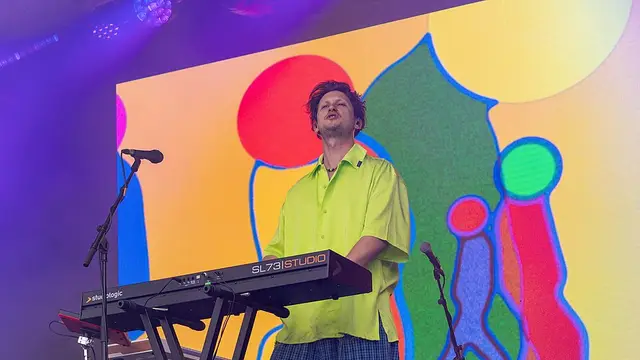
Josh Dibb's project — named with the kind of wry, self-deprecating deflection that is itself a recognisable mode of Scottish cultural self-presentation — arrives within this lineage as a specific synthesis rather than a departure from it. The approachable surface and the serious interior are both real. The name functions as a kind of protective irony around music that takes the dancefloor and the emotions it hosts with complete seriousness.
His production draws on broken beat and UK jazz-adjacent sounds that developed within London's early 2010s scenes, but reprocesses them through a sensibility rooted in Glasgow's longer relationship with emotionally weighted dance music. The London references are audible but they are not the point. What he does with them — the way they are bent toward a particular kind of feeling, a particular kind of room — locates them within a different tradition than the one they came from. Influence is always a story about what is done with the borrowed material.
The use of live instrumentation — guitar, piano, fragments of voice — within electronic frameworks is not decorative. It extends a recurring Scottish tendency to resist the hard separation between club music and song-based traditions. Scotland has a long relationship with music that is simultaneously emotionally direct and formally rigorous — from the folk tradition through post-punk and into the electronic present — and that relationship keeps resurfacing in artists who, on the surface, have little to do with each other. Dibb's music is house music, but it is house music that remembers other kinds of music, and that memory changes what it sounds like.
His signing to Atlantic Records placed him within major-label infrastructure while his aesthetic remained grounded in independent club-culture values — a tension that has clear precedent in how Scottish artists have historically navigated industry relationships. Rustie signed to Warp. Numbers operated in dialogue with international attention. The question was never whether to engage with the wider industry but how to engage without surrendering the dancefloor accountability that made the work worth engaging with in the first place. His sets, which blend original material with DJ selections in a fluid continuum, reflect the Optimo-era insistence that the producer and the DJ are not separate roles but two aspects of a single relationship to the room.
Outsider Conditions and the Production of Sound
The structural conditions that shaped Scottish electronic music — economic, geographic, institutional — produced a recurring set of aesthetic values across different generations. This is not a mystical claim about Scottish culture. It is an argument about how conditions shape practice. The absence of major-label presence in Glasgow and Edinburgh for most of the electronic era meant that artists developed sounds for local audiences rather than A&R expectations. Music calibrated to room response sounds different from music calibrated to format compliance. The difference is audible in the work.
Economic contraction in post-industrial Scottish cities created both the necessity and the cultural permission to repurpose disused spaces as venues. The same pattern has been documented in Detroit, in Berlin, in Manchester — cities where economic pressure cleared space, sometimes literally, for club culture to establish itself in buildings that had lost their original function. The aesthetics of those spaces — their acoustics, their social atmospheres, the particular freedoms that come from occupying a space no one else wants — became embedded in the music made within them.
Scottish artists have historically maintained a pragmatic relationship to genre. American house and techno, European club culture, British rave, post-punk, folk — these are all available materials, none of them carrying the weight of tribal loyalty. The eclecticism is not casual. It reflects a scene that absorbed influences from multiple directions because it had no single dominant tradition to defend. The result is a characteristic openness to combination — an ability to hold contradictory sounds in productive tension — that has produced some of the most formally interesting electronic music to come out of Britain.
The emotional directness associated with Scottish folk and rock traditions — from the Proclaimers to Frightened Rabbit — has permeated even purely electronic work in ways that are difficult to fully account for but impossible to ignore. There is a cultural disposition toward sincerity in Scottish music that cuts across genre, a sense that the affective content of a piece is as important as its formal architecture. This is not sentimentality. It is a different calibration of what music is for.
What the Centre Cannot Manufacture
The history of Scottish electronic music suggests that scenes defined by geographic and industrial peripherality produce not despite those conditions but through them. The outsider position generates the specific values that make the work distinctive — and those values are not easily exported without the conditions that produced them. The centre has repeatedly noticed what Scottish electronic music does and attempted to replicate it. It has not succeeded, because what it is attempting to replicate is not a set of techniques but a set of pressures.
The recurring tension in Scottish electronic careers — between local accountability and international ambition — maps onto a broader question that faces any peripheral scene that achieves wider recognition: whether scenes can export their values or only their products. The values are formed in specific places, between specific people, under specific conditions. When artists leave those conditions — when they move to London, sign to majors, build audiences that have no relationship to the original room — something shifts. Not always catastrophically, and not always in ways that destroy the work. But something shifts.
Barry Can't Swim's navigation of major-label visibility while retaining a connection to club-culture values is legible to anyone familiar with how Optimo was received outside Scotland, how Rustie's Warp tenure played, how Numbers label releases were absorbed by international audiences: with admiration from the centre and occasional suspicion from the periphery. The periphery has always been the more rigorous critic. It is the community that formed the values in the first place, and it is the community most able to identify when those values are being honoured and when they are being performed.
The question of what a scene loses when its most visible figures move toward the centre is not unique to Scotland, but Scotland's scale and cultural self-consciousness make the tension unusually visible. This is a small country with a large sense of its own cultural specificity. That combination — small enough for personal relationships to carry real weight, self-conscious enough to maintain a continuous conversation about its own identity — produces scenes that are unusually aware of what they risk. It also produces artists who carry that awareness into their work.
What Scottish electronic music demonstrates, across its full generational span, is that the conditions of making music at the edge of the map are not a handicap to be overcome. They are a set of pressures that produce particular kinds of seriousness — a seriousness rooted in the dancefloor, in the post-industrial city, in the room with the low ceiling and no natural light. The centre has resources. It has infrastructure, investment, visibility, access. What it does not have, and cannot manufacture, is the specific urgency that comes from making music for a community that depends on it, in a place that offers no other validation. That urgency is what you hear in the lineage. It is what you hear, still, in the bass in the basement.

シェア
会話に参加するにはログインしてください。 ログイン
まだコメントはありません。最初のコメントをどうぞ。