The Room Where It Happened: South London Jazz and the Logic of Collective Formation
In the mid-2000s, a weekly session was taking place in a room beneath a South London church. Young musicians — teenagers mostly, some younger — were learning repertoire, working through theory, and, more importantly, learning how to listen to each other. The music coming out of that room would take years to reach the wider world. But the logic shaping it — communal, diasporic, rooted in place — was already fully formed.
That room was Tomorrow's Warriors. And the logic it embodied, carried forward by the musicians who passed through it, is the clearest explanation available for why London's jazz scene developed the way it did.
Formation
Understanding what that means — what shared formation actually produces in a group of musicians — is the starting point for any serious account of the scene. It is not simply that musicians knew each other. Plenty of scenes involve musicians who know each other. What Tomorrow's Warriors produced was something more specific: a shared set of values about what music was for, who it was for, and how it should be made.
Gary Crosby founded Tomorrow's Warriors in 1991. Working from a clear-eyed understanding of the absences that structured Black British musicians' lives — the missing mentors, the closed doors, the assumption that certain repertoires belonged to other people — he built an institution designed to address those absences directly. It was a deliberate intervention in the civic and cultural landscape, embedded initially within the South Bank's Purcell Room, later expanding as its alumni began to make names for themselves.
Ezra Collective — built around drummer and bandleader Femi Koleoso, whose brother TJ plays bass and whose close collaborators came up through the same networks — did not arrive fully formed. They arrived out of a formation. The distinction matters. A fully formed group has its sound. A formed group has its values, and the sound follows.
The Church Underneath the Music
Any account of this scene that ignores the role of Black British church culture is incomplete. The call-and-response nature of gospel practice maps directly onto the improvisational ethics of the jazz these musicians make: the idea that a soloist speaks and the band responds, that no voice is ever entirely alone, that the congregation — the audience — is part of the music rather than separate from it.
This is not metaphor. Musicians who grew up playing in church learned, before they ever sat in a jazz ensemble, that music is a collective act with a social function. They learned that virtuosity is not the point; connection is the point. They learned that the room matters.
Femi Koleoso has spoken about this directly in interviews. So has Moses Boyd. So has Nubya Garcia, who grew up in a family embedded in Caribbean and South American musical traditions with their own versions of the same ethic. The through-line is consistent: music as practice, music as community, music as something that happens between people rather than in front of them.
The London Part
It is worth being specific about geography, because the scene did not emerge from London in the abstract. It emerged from particular parts of London — South London primarily, with nodes in East London as the scene developed — and those parts of London shaped it.
These are areas with dense, overlapping diasporic communities: Caribbean, West African, East African, South American. The musical cultures those communities brought with them, and the musical cultures they developed in Britain across generations, created a particular kind of sonic environment. Growing up in it meant growing up with Afrobeats and reggae and soca and grime as well as jazz, and the music these artists make carries all of it.
This is different from fusion as a compositional strategy. It is not that these musicians decided to incorporate other genres. It is that the other genres were never separate to begin with. When Shabaka Hutchings plays, you are hearing someone for whom Coltrane and calypso and the South London street are a single continuous tradition, because for him they are.
The Venues
The institutional infrastructure that allowed this scene to develop in public deserves attention. Ronnie Scott's in Soho and the Jazz Cafe in Camden each represented something different — intimate and experimental at one end, established and institutional at the other — and the scene moved fluently between them and the spaces in between: Total Refreshment Centre in Hackney, which for several years functioned as a laboratory; Peckham and Brixton venues that kept the music close to the communities it came from.
The BBC played a significant role. Jazz on 3, later rebranded as J to Z, provided broadcast infrastructure for a scene that mainstream radio was not yet ready to programme. When Gilles Peterson dedicated airtime and institutional energy to these artists, it mattered — not because his endorsement was required, but because the infrastructure he represented opened distribution channels.
The streaming era changed the calculus significantly. Albums like Ezra Collective's *You Can't Steal My Joy* (2019) and Moses Boyd's *Dark Matter* (2020) reached audiences in Lagos and Toronto and Melbourne without requiring those audiences to first encounter the music through traditional gatekeepers. The scene's self-sufficiency, developed through years of operating outside mainstream channels, became an asset rather than a limitation.
The Music Itself
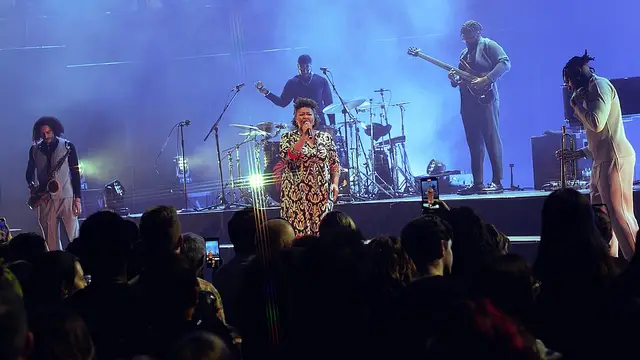
Description risks flattening what is genuinely various. This is not a unified sound. Nubya Garcia's tenor saxophone work — rooted in the tradition but pushing at its edges harmonically — sounds different from Theon Cross's tuba-centred compositions, which sound different from Kokoroko's Afrobeat-inflected ensemble work, which sounds different from the electronic textures Moses Boyd incorporates into his production.
What they share is not a sound. What they share is an approach: democratic, responsive, oriented toward collective rather than individual expression. Soloists do not dominate. The rhythm section is not accompaniment; it is co-equal. The music breathes differently from jazz that prioritises individual virtuosity.
This approach has roots in specific traditions — in the fire music of the 1960s, in the AACM's collective practice, in the communal ethics of African musical traditions — but it has been developed into something new. It is not revival. It is continuation by other means.
Inheritance
The question of where this music comes from involves being clear about what it inherits and what it departs from.
It inherits from the American jazz tradition — there is no serious case that it does not — but it does not treat that tradition as the only tradition or the primary one. The musicians who formed this scene grew up in Britain, in Black British communities, with Black British cultural histories. The jazz tradition was available to them, but so were other things.
The result is music that is in conversation with the American tradition without being subordinate to it. When critics have sometimes described this scene as a British version of something that happened in New York or Chicago, they have it backwards. This music is not a version of something else. It is its own thing, with its own lineage.
The distinction matters because it changes what we hear. If we listen for this music's relationship to American jazz, we will find it, and it will seem derivative. If we listen for its relationship to Black British culture — to the full range of what that means — we will find something more interesting.
What Comes Next
The scene has spent several years under significant attention, and the question of how to maintain community orientation — how to keep the music answerable to the communities it came from rather than primarily to the markets that have embraced it — becomes more pressing as commercial success grows.
Some artists have navigated this thoughtfully. Kokoroko's decision to remain a collective rather than become a vehicle for individual stars reflects a values commitment that has survived success. Tomorrow's Warriors continues to operate as a youth programme; Crosby's founding logic remains active. Moses Boyd has spoken about the importance of keeping work connected to South London even as his profile has become international.
Others have moved toward more straightforwardly commercial territory, and there is no particular reason to condemn that. Music careers are difficult; the infrastructure of the independent scene is precarious; artists have to make choices. But the tension is real, and the scene's most interesting question going forward is whether the values that produced it can survive the attention it has attracted.
The honest answer is that they might not, entirely. Scenes do not stay scenes; they become genres, then they become histories. What Tomorrow's Warriors built may already be in the process of becoming its own mythology.
But the music exists. The recordings are there. And anyone who wants to understand what happened — how a room beneath a South London church produced something that would eventually reach the world — can go back to the logic that shaped it from the beginning: that music is made together, for people, in places. That formation matters more than talent. That the room is never incidental.

Share
Sign in to join the conversation. Sign in
No comments yet. Be the first to share your thoughts.