The Vejigante Mask and the Cultures That Made It
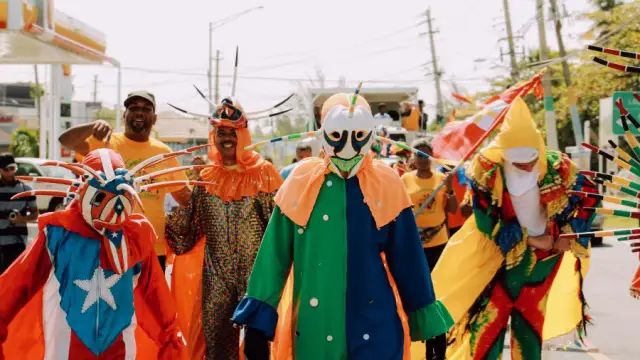
The mask arrives before anything else. Horns first — sometimes dozens of them, spiraling outward from a papier-mâché shell painted in reds, yellows, blacks, and electric blues — and then the figure beneath, moving through a crowd that parts and reforms around it. The vejigante is one of the most recognized symbols in Puerto Rican cultural life, and among the most misunderstood. To encounter it only as image, stripped of the festivals and communities that sustain it, is to miss most of what it means.
Two Traditions, Two Cities
The vejigante mask tradition exists in two distinct forms, rooted in two cities with different histories and different relationships to the African and Spanish elements that shaped Puerto Rican culture. Ponce, on the island's southern coast, and Loíza, a coastal municipality to the northeast of San Juan, each developed their own version of the figure, and the differences between them are not incidental. They reflect genuine divergences in community, material, and meaning.
The character, also called the vejigante, historically moved through carnival crowds carrying a vejiga — an inflated animal bladder or, later, a balloon — which it used to bat at spectators. The word itself comes from this object. The costumed figure was disruptive by design, a licensed fool whose job was to unsettle the orderly procession of the carnival, particularly the religious elements. That license to disrupt, and the mask that enabled it by concealing identity, gave the vejigante a social function that went beyond entertainment.
Ponce: Carnival and the Creole City
Ponce's Carnival, held each February in the days preceding Ash Wednesday, traces its roots to the early 19th century, its history bound up with the city's Afro-Puerto Rican and mixed-race communities who claimed the streets despite, and explicitly in defiance of, the racial hierarchies that structured colonial Puerto Rican society. The mask allowed for a temporary suspension of those hierarchies, or at least their visible markers. Behind papier-mâché and paint, social identity became unstable.
The Ponce mask is an elaborate papier-mâché construction. Artisans build the masks in layers, applying strips of paper over molds, allowing each layer to dry before adding the next. The process is labor-intensive and skilled, requiring knowledge passed through families and workshops over generations. The finished masks are characterized by their multiple horns — sometimes upward of two dozen — and by their vivid polychrome surfaces. The color combinations follow aesthetic traditions that have evolved over more than a century, with particular families and workshops developing recognizable styles.
The carnival context matters here. Ponce's Carnival has always been a structured event with its own internal logic: the procession of the carnival queen, the mock burial of the sardine on the final day, the competitions among mask-makers. The vejigante figure moves within this structure while also disrupting it, which is the point. The tradition is not a static display but a living practice with its own internal tensions.
Loíza: Coconut Shell and Santiago
Loíza is a different kind of place: a coastal municipality with one of the highest concentrations of Afro-Puerto Rican residents on the island, a community that maintained African cultural continuities through the colonial period with unusual persistence. The Fiestas de Santiago Apóstol, held each July in honor of Saint James, are a statement worth pausing over. The syncretism embedded in the festival — an African-inflected community celebrating a Spanish Catholic saint — reflects the layered negotiations that characterize much of Caribbean religious and cultural life.
The Loíza vejigante mask is made not from papier-mâché but from the dried shell of a coconut. The material difference is significant. Coconut shells impose their own constraints and possibilities: the maker works with a form that is already determined in its basic shape, carving rather than building. The resulting masks are smaller, more contained, with a different visual register than the sprawling papier-mâché constructions of Ponce. The horns of the coconut mask are typically fewer and shorter; the overall effect is more intimate, more directly tied to the material from which it came.
Castor Ayala, known widely as Toro Bello, achieved renown as a coconut-shell mask maker in Loíza during the 20th century, and his work helped to establish the aesthetic standards against which subsequent makers have measured themselves. His legacy is actively maintained by his family, who continue to make masks in Loíza.
Diaspora and the Question of Continuity
The mid-20th century diaspora, with Puerto Ricans migrating in large numbers to New York, particularly to the Bronx and Brooklyn, created new conditions for cultural practice. The festivals of Ponce and Loíza could not be transplanted wholesale, but elements of them traveled with the people who carried them. Puerto Rican communities in New York developed their own carnival and festival traditions, some of which incorporated vejigante imagery and mask-making.
This is where questions of transmission and transformation become particularly acute. A tradition practiced in diaspora is necessarily a tradition practiced under altered conditions. The materials may be different, the community may be dispersed rather than geographically concentrated, and the relationship to the original context is mediated by distance and time. Whether diaspora practice constitutes continuation, adaptation, or something else entirely is a question that communities answer differently, and the answers are often contested.
Working through the 1970s within a broader Caribbean consciousness movement reexamining the African roots of island cultures, Puerto Rican intellectuals and cultural nationalists began to insist more forcefully on recognizing the African dimensions of traditions like the vejigante. This reexamination was not simply academic. It had practical implications for how communities understood their own practices and for which elements of the tradition were emphasized in transmission and performance.
Music and the Broader Cultural Frame
Bomba, a drum-and-call tradition with direct roots in the musical practices of enslaved West Africans in Puerto Rico, is the primary musical form associated with the Loíza tradition. The relationship between bomba and the vejigante festival is not merely incidental accompaniment; the music and the masked figure are part of the same cultural complex, emerging from the same community history.
Contemporary Puerto Rican musicians have engaged with this history in varying ways. The work of Los Pleneros de la 21, a New York-based group dedicated to the preservation and transmission of bomba and plena, represents one model: deep, sustained engagement with the forms themselves, combined with deliberate pedagogical work aimed at ensuring transmission to younger generations. Projects like the Calle 13 project, in which Residente and Visitante spent years embedding themselves in the musical traditions of Puerto Rico and the broader Latin American world, have drawn significant attention to the question of roots and contemporaneity, though with a different set of priorities and a different audience.
The Image and Its Risks
The tension between visibility and flattening is real and ongoing. When a tradition travels through mass media, it risks being received as spectacle stripped of meaning — the image circulating freely while the knowledge that animates it stays behind.
The 2020 Super Bowl halftime show, in which Jennifer López appeared alongside a group of performers wearing vejigante-style masks, brought the image to an audience of tens of millions. Dancer and choreographer Jill Renee Carrión, who worked on the production, spoke publicly about the effort to ensure that the masks were made by Puerto Rican artisans and that the representation was grounded in actual knowledge of the tradition. Whether those efforts succeeded, and to what degree the broadcast context allowed for meaningful transmission rather than mere spectacle, is a question without a clean answer. Carrión's moment connects to a longer arc of Puerto Rican performers, from Rita Moreno to Bad Bunny, who have used mainstream platforms to insist on the specificity and depth of Puerto Rican cultural identity rather than allowing it to be absorbed into a generalized Latin American or Hispanic category.
The mask appears on tourist merchandise, in advertising, in fashion: a sign of the tradition's visual power and its recognizability. The image travels easily because it is striking, immediately legible as "Puerto Rican" to audiences who may know nothing else about the island's cultural history. The communities most invested in the tradition are aware of this risk and navigate it with varying strategies, some welcoming exposure, others insisting on context as a condition of representation.
What the Mask Carries
The vejigante mask is the most elaborate and colorful expression of a culture that has spent centuries negotiating its own complexity. The African, Spanish, and indigenous Taíno elements that compose Puerto Rican culture are not always held in easy balance, and the mask does not pretend otherwise. Its function has always been disruption, the unsettling of settled arrangements, the introduction of something ungoverned into governed space.
That function has not disappeared. The mask still moves through crowds, still unnerves, still asks something of the people who encounter it. Whether those people know what they are encountering depends entirely on the context in which they meet it — and on whether those who carry the tradition forward have been able to transmit not just the image but the knowledge that makes the image mean something.
The horns spiral outward. The crowd parts. The figure moves through.

Share
Sign in to join the conversation. Sign in
No comments yet. Be the first to share your thoughts.