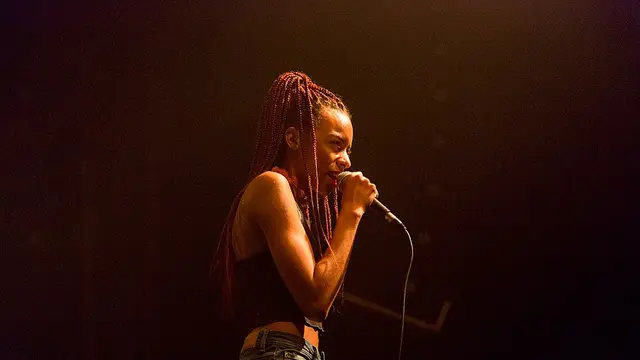
Picture the south edge of the Chicago metropolitan grid on a January night. The light comes in low and amber from the storefronts, the wind has a particular authority off the lake, and somewhere inside one of the neighborhoods that rings the city proper, somebody is singing. Not performing — singing. Holding a note the way you hold something that matters to you, with care and with the knowledge that you might eventually have to let it go. This is the sound Ravyn Lenae makes, and it did not appear from nowhere. It was built by a city.
A City That Builds Voices
Chicago's relationship with Black vocal music is not incidental. It is structural — encoded in the architecture of its neighborhoods, in the specific social geography that segregation produced, in the church circuits and supper clubs and basement studios that gave generations of singers somewhere to develop their craft before the wider world had any occasion to hear them. The South Side functions less like a neighborhood and more like an institution, a place where the conditions for a very specific kind of musical seriousness were laid down long before any individual artist arrived to inhabit them.
What those conditions produced resists easy genre labeling. The Chicago sound in soul is not a tempo or an instrumentation — it is a temperament. Sophisticated without being cold. Warm without being soft. Capable of holding joy and hardship in the same phrase without pretending that either cancels the other out. It is a sound shaped by a blues-rooted understanding that difficulty and pleasure are not opposites but traveling companions, and that the most honest music acknowledges both at once.
Ravyn Lenae is a fluent speaker of this temperament. When she named her 2022 album *Blue Island* after a small city on Chicago's southwestern edge, she was not reaching for an evocative image. She was performing an act of geographic self-placement, declaring her coordinates within a tradition that demands you know where you come from. Chicago's singers don't merely originate in the city. They are shaped by its particular combination of community density, institutional memory, and an emotional climate in which warmth is not naivety but a form of resistance.
Minnie, Chaka, and the Lineage of Extraordinary Women
The female vocal lineage that Lenae inhabits did not begin with her, and it did not begin with her most obvious precursors. It runs back through Chaka Khan and Minnie Riperton to a moment in Chicago's cultural life when the city's institutions were producing singers of extraordinary range and seriousness — artists whose technical ambition and emotional depth were so intertwined that separating the craft from the feeling became impossible.
Riperton's formation is inseparable from Chicago's geography. Her training at the Lincoln Center for the Performing Arts in Hyde Park gave her a classical foundation that she folded into something entirely new with The Rotary Connection, a group whose late 1960s recordings fused psychedelic rock, orchestral arrangement, and soul in ways that had no real precedent. What the city gave Riperton was not a sound but a permission — permission to treat soul music as a site of compositional ambition, to refuse the ceiling that genre convention tried to impose on her extraordinary seven-octave range.
Khan's emergence from the South Side's late 1960s ferment tells a different but related story. The Association for the Advancement of Creative Musicians, whose shadow fell across so much of Chicago's serious music in that era, had established that Black music could be analytically rigorous and politically accountable at the same time. The Black Arts Movement had made cultural production a form of community responsibility. The club scene demanded that a singer hold a room with full-spectrum presence — there was no room for half-measures. Khan absorbed all of this and delivered it through a voice of almost physical intensity.
What these artists share beyond technique is a refusal to choose between accessibility and depth. Neither Riperton nor Khan made music that required an instruction manual, but neither made music that flattened itself for easy consumption. This particular balance — pop pleasure held in tension with serious emotional reckoning — is a Chicago inheritance, and it runs through the gospel infrastructure that quietly underpins the entire tradition. The expectation that a singer must hold a room and mean it, that emotional conviction is not optional but foundational, comes from the church. Everything else is built on top of that.
Chicago women in soul have historically occupied a lane between the earthiness of Southern soul and the polish of Motown — a middle geography, sonically and spatially, that produces its own distinct voice. Warmer than the North, more self-possessed than the South, more emotionally direct than either coast. Lenae inhabits this lane as if she has always known it was there waiting for her.
The Label Map: Chess, Curtom, and the Infrastructure of Black Chicago Sound
Traditions are not only carried by artists. They are built by infrastructure — by the labels, studios, and business ecosystems that determine what gets recorded, how it gets distributed, and what kind of musical identity a city projects to the world. Chicago's soul and R&B history is inseparable from its independent label history, and understanding that history helps explain why the city's sound has the particular character it does.
Chess Records was the foundational institution. Founded by Leonard and Phil Chess in the late 1940s, it translated Mississippi Delta blues into an urban, electric idiom — denser, more percussive, shot through with the energy of a city that had absorbed a Great Migration's worth of Southern talent and given it new context. The racial economics of Chess were complicated, its profits distributed in ways that did not always serve its artists equitably, but the sonic identity it forged was genuinely new. What Chicago did with the blues planted seeds that soul, funk, and eventually hip-hop would all draw from.
Curtis Mayfield's Curtom Records, established in 1968, operated as something closer to a corrective model. Black-owned, politically conscious, and sonically ambitious, Curtom produced records that treated community accountability and compositional sophistication as inseparable. Mayfield's string arrangements, his falsetto, his willingness to make protest music that was also genuinely pleasurable — these were not compromises but convictions. Curtom demonstrated that the infrastructure of Black music could serve Black artistic vision without the concessions that majority-owned labels typically imposed.
When independent label infrastructure collapsed across the 1980s and 1990s, Chicago's artists adapted rather than disappeared. The city's musical energy migrated into house music, gospel crossover, and eventually the neo-soul underground — forms that preserved the emotional seriousness of the soul tradition while finding new containers for it. By the time artists like Lenae arrived, the label landscape had been transformed entirely by digital distribution, but they were still operating within a city whose musical identity had been forged by those earlier institutions. The buildings may change; the temperament persists.
Blue Island: Geography as Artistic Statement
Blue Island is a real place. It sits just southwest of Chicago proper, a small city of working-class history positioned at the edge of the metropolitan grid — close enough to Chicago to be shaped by it, far enough to maintain a distinct identity. It is, in the most literal sense, a place that is of Chicago but slightly outside it, and this spatial relationship — belonging to a larger entity while preserving an interior separateness — is exactly the artistic posture Lenae's music projects.
The resonance of *island* as metaphor does significant work here. An island is not isolated — it is surrounded, defined by its relationship to what encircles it. Lenae's music has this quality: it exists in conscious relationship to Chicago's cultural energy, shaped by the city's gravity, but it maintains a distinct interior life that is not simply a reflection of the larger scene. The album is warm without being communal in any easy sense. Its intimacies are private even when they gesture outward.
Sonically, *Blue Island* maps onto this emotional geography with considerable precision. The orchestral textures, the unhurried pacing, the refusal of aggressive contemporaneity — these are not retro gestures but decisions that create the conditions for a certain kind of attention. The album asks you to sit with it rather than process it. Its warmth is not the warmth of surface pleasure but something more sustaining, more considered. It sounds like a place you could actually live in.
Naming music after place has its own tradition in Chicago. Kanye West wove the city's iconography through his early albums as a declaration of origin and pride, establishing that Chicago artists could claim their geography as artistic identity rather than mere biographical detail. Chance the Rapper's *Acid Rap* functioned as a document of a specific neighborhood moment, a record that couldn't have been made anywhere else. Lenae operates within this tradition of deliberate spatial identification, though her version of it is quieter and more inward — less a declaration than a coordinates entry, a precise notation of where she stands.
The Emotional Climate: Warmth Under Pressure
There is a specific emotional register that Chicago soul produces, and it is not accidental. It emerges from the city's particular conditions — the history of racial segregation and neighborhood displacement that made joy a form of knowledge rather than innocence, the winters that drove communal interior life, the density of a city where people lived close enough together to make music something shared rather than merely consumed. Warmth under pressure is not a stylistic choice in this tradition. It is a cultural inheritance.
This distinguishes Chicago soul from related traditions in instructive ways. It lacks the melismatic release of Southern soul, where the voice itself becomes the vehicle for catharsis. It maintains more emotional directness than the ironic distance that New York R&B has sometimes favored. It refuses the surface gloss that Los Angeles pop so often privileges. What it produces instead is a particular combination of feeling and awareness — music that is fully present to difficulty without being defeated by it, that finds warmth not despite the pressure but through it.
Lenae's vocal and compositional approach embodies this register with the ease of someone who absorbed it before she could articulate it. Her arrangements build toward warmth the way a good fire builds — steadily, with attention to the conditions, without pretending that there is no cold outside. Her lyrics treat intimacy as a serious subject, not merely a romantic one. The negotiation of love and selfhood in her songs carries the weight of someone who understands that these negotiations take place inside a larger context, a world that doesn't always make them easy.
This is not a register unique to Lenae among her contemporaries. Jamila Woods makes music that holds the same combination of intellectual seriousness and emotional generosity. Saba's rap balances grief and beauty with a precision that places him squarely in the same tradition. Noname's work carries a political clarity that coexists with genuine lyrical warmth. These are not artists who arrived at similar sounds by coincidence. They are products of a living cultural condition — a Chicago way of being in music that is being actively transmitted and renewed, not nostalgically recovered.
What the Continuum Demands: Responsibility, Craft, and What Comes Next
Great traditions are not passive inheritances. They make demands. To be a conscious heir to Chicago's Black vocal lineage is to be in conversation with Riperton's range, Mayfield's political seriousness, Khan's full-spectrum intensity, and the gospel discipline that underpins all of them. That conversation requires craft — real craft, not the simulacrum of it that competent professionalism can produce — and a willingness to acknowledge the weight of what came before without being crushed by it.
Lenae's formation includes the institutional dimension of this inheritance. Her time at CAPA — the Chicago High School for the Arts — placed her inside a pipeline of serious musical education that the city has maintained for its young artists, a pipeline that has produced a notable stream of musicians who arrive at their careers with genuine technical foundations. This is not an accident of individual talent. It is the city continuing to build its singers deliberately, with the same institutional intentionality that the Lincoln Center for the Performing Arts brought to Riperton's training decades earlier.
The global reach of Chicago's musical influence matters here as context. The tradition Lenae inhabits is not provincial. Chess Records shaped how electric blues spread across the Atlantic. Curtis Mayfield's orchestrations entered the DNA of British soul. House music — Chicago's adaptive response to the collapse of its soul infrastructure — became one of the most globally distributed musical forms of the late twentieth century. When Lenae makes music that carries Chicago's temperament, she connects to an international audience that may not know the geography but knows the sound, an audience that has been shaped by this city's musical exports without necessarily knowing their origin.
What comes after *Blue Island* is not a question about commercial trajectory. It is a question about what this ongoing conversation between an artist and her city produces when both parties continue to take it seriously. Chicago has demonstrated across decades that it does not simply produce artists and release them into the world. It shapes them, marks them, gives them a specific emotional and intellectual vocabulary, and then watches to see what they do with it. The city's singers carry that vocabulary wherever they go.
What makes Chicago keep producing this kind of singer is not luck, or some mystical property of the lake wind, or even raw talent distributed unusually well. It is a living culture of transmission — mentorship, community, institutional memory, the passing of a particular seriousness from one generation to the next in church pews and high school conservatories and the kind of musical friendships that form when serious young artists find each other in a city that rewards that seriousness. Ravyn Lenae benefits from all of this. She also contributes to it. The continuum runs through her, and beyond her, into whatever Chicago is building next.

Shiriki
Ingia ili kushiriki mazungumzo. Ingia
Bado hakuna maoni. Kuwa wa kwanza kushiriki mawazo.