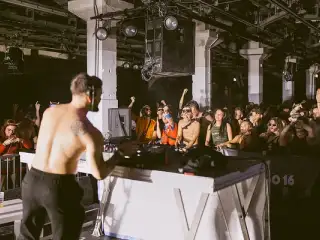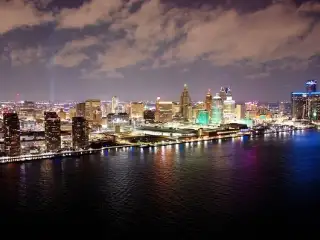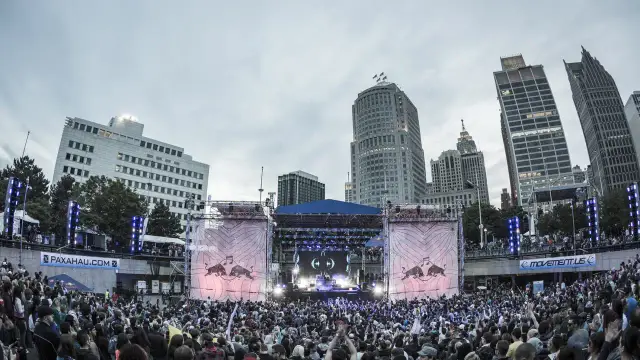
Picture Hart Plaza at dusk, the Detroit River catching the last flat light behind it, Windsor's low skyline visible across the water like a rumor of elsewhere. The sound coming off the main stage is hard and precise, built from drum machines and synthesizers, and it carries a particular weight that most festival music does not — not the weight of spectacle or commerce, though both are present, but the weight of argument. This music was made to mean something. The city it returns to every year has never stopped making that meaning necessary.
Born from the Ruins: Detroit's Radical Sonic Invention
Detroit techno did not emerge from leisure or abundance. It was forged in the specific conditions of post-industrial Black Detroit, where deindustrialization, white flight, and municipal abandonment had created both a crisis and a creative vacuum. By the late 1970s and into the 1980s, the gutting of the auto industry had decimated the Black working-class economy that had made Detroit one of the great American cities of the twentieth century. What remained was a psychological and material landscape that demanded either despair or invention.
The invention came, improbably, from a suburb. Juan Atkins, Derrick May, and Kevin Saunderson — the so-called Belleville Three — grew up in Belleville, Michigan, close enough to Detroit to feel its gravity and its wounds. What they built, in basements and bedrooms, had no obvious precedent: the cosmic funkadelia of Parliament and the robotic precision of Kraftwerk, collapsed into a single aesthetic that was distinctly, irreducibly Black American in its relationship to technology. They did not use machines as novelties. They used them as instruments of liberation.
Atkins, working with Richard Davis under the alias Model 500, gave the music its name and its theory at once. Drawing on Alvin Toffler's writing about the "techno rebels" of the information age, Atkins articulated a vision of techno as post-human and post-racial, reaching past the immediate catastrophe of deindustrialized Detroit toward a future the city's destroyers had not imagined. The founding gesture was a direct inversion of the narrative that automation had destroyed Black Detroit — a reclamation of the machine as a tool of those the machine had displaced.
The Philosophy of the Machine: Futurism as Resistance
What separated Detroit techno from the electronic music scenes emerging in the same era was not primarily sonic — it was ideological. The music arrived with a deliberate, articulated vision of what it was for and who it served. Derrick May's oft-quoted description of techno as "George Clinton and Kraftwerk stuck in an elevator" names the hybrid, contradictory tension at the music's core: deeply soulful and radically mechanical, rooted in Black American experience and simultaneously reaching toward something beyond geography and time. That tension was not a contradiction to be resolved but a productive friction to be inhabited.
The lineage is Afrofuturist. Running from Sun Ra through George Clinton and beyond, that tradition holds that machines and technology are not dehumanizing forces but tools for imagining and constructing alternative futures unavailable through mainstream social structures. Detroit techno planted itself squarely there. The music's machines did not represent the factory that had consumed a generation of Black Detroit's labor; they represented the possibility of building something else entirely, on different terms, toward different ends.
This philosophical content distinguished Detroit techno from European electronic music movements that adopted its sonics while often stripping its social meaning. That tension — between an aesthetic as international commodity and as locally rooted political act — has animated debates within the global electronic music community for decades without resolution. Futurism as resistance is not merely metaphorical: in a city systematically abandoned by capital and government, imagining a different world through sound was a political act with direct roots in the blues tradition of transforming suffering into transcendence.
Transmission Lines: How the Sound Traveled and What Survived the Journey
The global spread of Detroit techno is one of the most remarkable cultural transmissions in late twentieth-century music history, and it happened before the infrastructure that makes such things routine existed. Underground tape trading networks, early labels like Transmat, Metroplex, and KMS, and the physical travel of DJs carrying records across the Atlantic built an organic diaspora of the music — cassettes and vinyl and personal relationships, before the internet existed to flatten those distances.
Berlin's embrace of Detroit techno following reunification in 1989 generated a parallel mythology around the music — one centered on post-Cold War freedom and hedonism, on the tearing down of walls both literal and metaphorical. That mythology was powerful and genuine, but it reframed the music's meaning away from its Black American roots. The Berlin that built its global reputation on the floors of Tresor and Berghain drew from the same sonic well as the east side of Detroit, but told a different story about the music, because its own wounds and freedoms were different.
Cities and scenes that adopted Detroit techno's architecture sometimes built their own commercial and cultural structures directly on top of it, eclipsing the originators in resources and visibility. Artists like Delano Smith — whose Detroit roots run deep and whose career has spanned decades of international touring — embody the experience of navigating a global scene built partly on foundations laid by people from their own community. That navigation demands constant cultural accountability, and it falls disproportionately on the people with the deepest investment in getting the story right.
What is remarkable is not the distortion but the survival. What arrives in a Tokyo club or a Berlin warehouse still carries traceable DNA from the east side of Detroit, even when that lineage goes unnamed. The music proved durable enough to survive translation, commercial exploitation, and geographic distance — evidence that its original construction was as rigorous as its founders claimed.
Movement and Memory: What a Festival Owes Its Origins
Movement Electronic Music Festival, held annually in Hart Plaza since its founding in 2000, occupies a singular position in electronic music culture. It is simultaneously a celebration and a reckoning — a place where the global scene that Detroit helped build returns, however briefly, to the source. The festival launched as the Detroit Electronic Music Festival, and that original conception was explicitly an act of cultural reclamation: an effort to root the global electronic music industry's attention back to the city whose artists had seeded it, with free admission making access a central value rather than an afterthought.
Hart Plaza is itself a historically loaded site. Built during the city's postwar optimism as a piece of civic infrastructure, subsequently neglected through its decades of decline, the plaza's position on the Detroit riverfront — with its direct sightline to Canada, to somewhere else — gives the festival a spatial poetry that any other location would lack. The return to this place, year after year, is not incidental. It is the mechanism by which the music performs its own memory.
The festival's programming decisions — which artists appear on which stages, how Detroit artists are balanced against international headliners, whose names anchor the lineup announcements — have been the subject of ongoing community debate. That debate is not a problem to be managed; it is the festival doing its most important cultural work. For artists like Rimarkable, who operate within Detroit's scene with deep knowledge of its history and social fabric, Movement represents both an opportunity and a test: the moment when the gap between the music's stated values and the commercial realities of festival culture becomes most visible and most difficult to ignore.
Movement functions as a ritual of accountability. An annual return to origin that asks practitioners and audiences alike to measure the present state of the music against the radical intentions embedded in its founding. Festivals rarely perform this function; most exist to celebrate an aesthetic rather than interrogate it. That Movement carries this additional weight is both a burden and a distinction.
The Carriers: Generations of Detroit Artists Holding the Line
The continuity of Detroit techno's founding philosophy across generations is not accidental. It is the result of deliberate transmission — mentorship, community infrastructure, and the ongoing labor of artists who understood that the music's meaning was inseparable from its social context. The mentor-apprentice structures within Detroit's scene, often informal and rarely documented, are as important to the music's continuity as any label or festival. They are how philosophy, not just technique, passes from one generation to the next.
Delano Smith's career illustrates how the founding generation's values — soulfulness, restraint, the dancefloor as a space of spiritual rather than merely recreational purpose — are carried forward not through nostalgia but through practice. Smith has moved through decades of international work without abandoning the commitments that Detroit's underground encoded in the music from the beginning. That consistency is itself a form of argument, a refusal to allow the music's commercial success on the global circuit to decouple it from the values that made it worth exporting.
Rimarkable's work within the Detroit scene shows how younger practitioners inherit not just a sonic vocabulary but a set of responsibilities: to the community that produced the music, to the dancefloor as a democratic space, and to the idea that electronic music can carry genuine emotional and political weight. This inheritance is not a burden imposed from outside but a framework generated from within — a way of understanding what the music is for that makes the work more demanding and more meaningful at once.
Detroit's ongoing material challenges — the city's 2013 bankruptcy was one of the largest municipal bankruptcies in American history — mean that artists who continue working from within Detroit do so against conditions that test the music's founding claims daily. Their persistence on the global circuit, often without the institutional support available to European counterparts, is itself a form of the resistance the music theorizes. A refusal, enacted in practice and over time, to cede the cultural territory that Detroit created.
The Unfinished Argument: Detroit Techno's Claim on the Future
Detroit techno was always a music about the future — imagined from a present defined by crisis, transmitted outward to scenes that could barely name their source, and sustained by practitioners who carry its ideas into conditions its founders could not have anticipated. The music's central proposition — that Black working-class people could use technology to imagine and enact their own liberation — remains as radical and as necessary as when Atkins first articulated it, because the conditions that produced that proposition have not been resolved. The problem the music answered is not historical. It is structural, and it persists.
The global electronic music industry's relationship with Detroit techno's origins is a microcosm of broader questions about how creative cultures from marginalized communities are absorbed, commodified, and repackaged by wealthier markets. The same pattern runs through blues, jazz, and hip-hop. What distinguishes Detroit techno's case is that its practitioners and advocates have, with increasing explicitness, named it. The rise of conversations about race, credit, and cultural ownership within electronic music communities worldwide — driven in part by artists and writers who have refused to allow Detroit's erasure to go unmarked — represents a belated but meaningful reckoning with debts long owed.
Detroit itself, in its ongoing struggle and reinvention, remains the most honest test of the music's founding claims. If futurism is resistance, then the artists still working from within the city — against economic precarity, against the temptation to relocate to better-resourced scenes, against the structural indifference that has characterized Detroit's relationship with outside capital for half a century — are the music's most rigorous practitioners. Their presence in the city is not sentiment. It is argument.
The enduring power of Detroit techno is ultimately inseparable from the enduring power of the question it poses to every dancefloor it reaches, from Hart Plaza to Tresor to a warehouse in São Paulo or Seoul: whose future are we imagining, and for whom? That question has no final answer. But the music that carries it — built from drum machines and synthesizers in the ruins of a city that capitalism abandoned and imagination refused to leave — has proven, across decades and continents, that it can keep the question alive long enough for someone to begin answering it honestly.

Share
Sign in to join the conversation. Sign in
No comments yet. Be the first to share your thoughts.