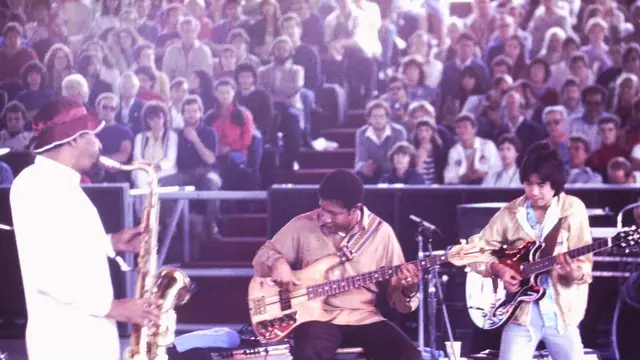
Seventy years ago this month, Sonny Rollins walked into Rudy Van Gelder's studio in Hackensack, New Jersey, and recorded an album that would eventually be pressed onto the spines of jazz history. *Saxophone Colossus* was not conceived as a monument. It was a working session for Prestige Records, one of several Rollins cut that year, and it lasted a single afternoon. The musicians — Rollins on tenor, Tommy Flanagan on piano, Doug Watkins on bass, and Max Roach on drums — ran through five tracks without excessive deliberation. The informality was structural. Prestige operated on tight budgets and trusted its musicians to arrive ready.
What emerged from that afternoon was something that resisted easy categorization then and resists it still. *Saxophone Colossus* is neither a hard bop manifesto nor a showcase for harmonic innovation. It sits in a productive middle space: accessible but not simple, swinging but not merely rhythmic, emotionally direct but technically rigorous. The album became a kind of standard against which later tenor playing would be measured, not because it announced a new direction, but because it demonstrated how thoroughly one musician had absorbed everything that came before and made it irreducibly his own.
The Session in Context
By June 1956, Rollins was twenty-five years old and had already spent years navigating the particular difficulties of being a young Black musician in mid-century New York — the economics of the scene, the omnipresence of heroin, the gap between critical recognition and financial stability. He had played with Thelonious Monk, Miles Davis, and the Modern Jazz Quartet. He had recorded as a sideman on sessions that became celebrated. He had also struggled with addiction in ways that interrupted his career and, by his own account, his sense of himself.
The Rollins who arrived at Van Gelder's studio in 1956 was not yet the dominant figure he would become, but he was someone who had survived enough to have a perspective. That survival, and what it cost, is audible on the record in ways that resist precise description but are nonetheless real. There is something in the phrasing — the unhurried certainty of his entry on "St. Thomas," the deliberate weight he brings to "You Don't Know What Love Is" — that suggests a musician who has stopped trying to prove something and started trying to say something.
The rhythm section deserves more attention than it typically receives in accounts of this album. Flanagan's comping throughout is a study in restraint; he provides harmonic context without crowding Rollins's melodic choices. Watkins anchors the time without drawing attention to itself. Roach, the most celebrated of the three, plays with characteristic intelligence — his brushwork on the ballads particularly delicate — but also subordinates his considerable personality to the demands of the session. This is not always how Roach played, and the fact that he chose to play this way here says something about what Rollins needed and what Roach understood.
"St. Thomas" and the Question of Roots
"St. Thomas," the album's opening track, has become so familiar that it requires deliberate effort to hear it freshly. The calypso-inflected melody, drawn from a folk tune Rollins's mother sang, is now one of the most recognizable openings in recorded jazz. Rollins was born in New York but his family roots were in the Virgin Islands, and "St. Thomas" represents one of the earliest moments in his recorded work where that Caribbean inheritance entered his music explicitly rather than as a subterranean influence.
What the track demonstrates, beyond its surface charm, is Rollins's understanding of how rhythm can function as argument. The melody does not simply swing in the jazz sense; it superimposes a Caribbean rhythmic logic onto the bebop vocabulary he had spent years acquiring. The effect is not fusion but integration — the two traditions do not sit side by side but genuinely merge. This was more compositionally radical than it sounded in 1956, and it anticipated by decades a widespread reckoning in jazz with the music's multiple geographic inheritances.
Rollins returned to "St. Thomas" throughout his career, and the various versions form an instructive archive of how a musician can inhabit the same material differently across time. The 1956 recording has a freshness, almost a surprise, that later versions lack — not because Rollins played it better then, but because he was still discovering what the tune could hold.
The Art of the Improvised Line
To call Rollins a great improviser is to say almost nothing, since most significant jazz musicians are great improvisers by definition. The more specific claim worth making about *Saxophone Colossus* is that it documents a particular kind of improvisational logic: one organized around motivic development rather than harmonic navigation alone.
Where many bebop players constructed solos primarily as sequences of harmonic moves through chord changes, Rollins worked differently. He would extract a small melodic cell from the theme and develop it through variation, inversion, and rhythmic displacement, sometimes holding onto a single idea far longer than conventional phrase-length would suggest. Analysts have compared this approach to that of Beethoven or Brahms — composers who built large structures from minimal initial material. The comparison is not hyperbolic. Rollins's solos on *Saxophone Colossus* have an organic architecture that rewards the kind of attention we bring to composed music.
This approach carried risks. A solo built on motivic development requires absolute commitment: if the idea is not strong enough, or if the development loses its logic, the whole structure collapses. On *Saxophone Colossus*, Rollins almost never loses the thread. "Moritat," the Weill composition better known as "Mack the Knife," is perhaps the clearest illustration. Rollins takes a melody most listeners already know and systematically dismantles and rebuilds it while never letting the listener lose track of the original. This is a hard thing to do, and watching him do it is one of the sustained pleasures of the album.
The Sabbatical and What It Means
No account of Rollins's artistic identity is complete without the sabbatical. In 1959, three years after *Saxophone Colossus*, Rollins withdrew from public performance and spent two years practicing alone on the Williamsburg Bridge in lower Manhattan — partly to avoid disturbing his neighbors, partly because the scale of the bridge suited something he needed to work through. He returned in 1962 with *The Bridge*, an album whose title acknowledged the provenance of its preparation.
The sabbatical has acquired mythological dimensions that can obscure its practical meaning. Rollins was not simply retreating to achieve enlightenment. He was a musician who believed, despite considerable critical success, that he had not yet solved certain technical and conceptual problems, and who chose extreme measures to address that dissatisfaction. The bridge practice sessions were, among other things, a choice to prioritize craft over career at a moment when career was going well.
This is worth dwelling on because it represents a model of artistic development that the music industry, then and now, structurally discourages. Rollins's willingness to disappear when disappearing seemed counterproductive is inseparable from the quality of the music he made. *Saxophone Colossus* is the document of one peak; the sabbatical is the evidence that Rollins understood peaks to be temporary and chose to keep climbing anyway.
A Career of Genuine Risk
Unlike contemporaries who died young, turned to fusion, or became nostalgia acts, Rollins took genuine musical risks across six decades. His early-1960s free-jazz explorations, heard on *The Bridge*, paralleled Ornette Coleman's but arose from his own expressive need rather than direct influence — perhaps the more interesting story.
The late-career recordings, often dismissed by critics who preferred the classic period, are full of evidence that Rollins continued to ask real questions. His tone on the soprano saxophone, which he took up later in life, is immediately recognizable yet distinctly different from his tenor sound. His choice of material in the 1980s and 1990s, which drew on pop and funk in ways that disappointed some admirers, reflected a genuine curiosity rather than a commercial calculation. He lost some listeners and retained others, and seemed largely unconcerned with the accounting.
What *Saxophone Colossus* Still Teaches
The pedagogical literature around *Saxophone Colossus* tends to focus on its technical lessons: motivic development, rhythmic displacement, the use of space. These are real and important. But the album teaches something harder to codify, which has to do with presence — specifically, the kind of presence that comes from having genuinely worked something out rather than having performed the appearance of working it out.
Listeners without formal training respond to this album in ways they cannot always explain. The explanations involve words like "confidence" or "maturity" or "soulfulness" — terms that feel inadequate but are pointing at something real. What they are pointing at, I think, is the sound of a musician who has earned his material: who knows, through hard experience, why each note belongs where it belongs.
Rollins himself remained skeptical of the album's canonical status in interviews, noting that he could hear in it everything he wished he had done differently. This is not false modesty. It is the perspective of someone who understood *Saxophone Colossus* as a waypoint rather than a destination — necessary but not sufficient, representative but not complete.
For listeners returning to the album at its seventieth anniversary, the invitation is to hear it the same way: not as a relic of a golden age but as a record of what was possible on one afternoon in June 1956, when a twenty-five-year-old musician with everything still ahead of him sat down and played with everything he already had.
Rollins's life and this album teach that a voice is not found once but continuously reclaimed — on bridges, in empty rooms, in the gaps between records. *Saxophone Colossus* documents one clear moment of that never-ending process.

Share
Sign in to join the conversation. Sign in
No comments yet. Be the first to share your thoughts.